



A Cosmic Chemical Factory
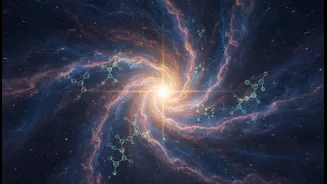
Scientists using the powerful James Webb Space Telescope (JWST) have uncovered an extraordinary treasure trove of carbon-rich compounds deep inside a distant galaxy. Peering through thick clouds of cosmic dust, they identified a mix of small organic molecules
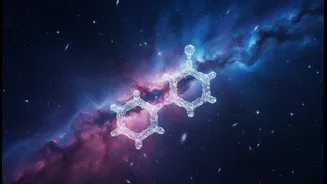
including benzene and methane. Perhaps most excitingly, they also made the first-ever detection of the methyl radical (CH3) outside of our own Milky Way galaxy. This highly reactive molecule is a crucial component in the formation of more complex carbon-based molecules, which are the foundation for life as we know it. The discovery was made in a galaxy known as IRAS 07251-0248, whose dusty core has long hidden its chemical secrets from less advanced telescopes.
Why This Discovery Matters
Finding organic molecules in space is not entirely new, but the sheer abundance and complexity found in this galaxy were unexpected. Researchers were surprised to find concentrations far higher than what current theoretical models predicted. This suggests that the centers of galaxies, even in harsh environments near supermassive black holes, can act as veritable factories for organic molecules. These findings provide a crucial link between the simple chemistry observed in interstellar space and the more complex molecules found in meteorites and comets within our own solar system. It suggests that the chemical groundwork for life doesn't just happen on planets, but begins in the vast, cold expanses between stars and even in the turbulent hearts of galaxies.
The Role of Sulphur
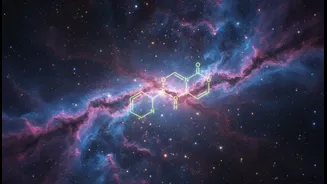
While the recent JWST discovery focused on hydrocarbons, other recent finds have highlighted the importance of another key element: sulphur. Sulphur is essential for life on Earth, forming critical parts of amino acids like methionine and cysteine, which are vital for proteins. For years, scientists were puzzled by the apparent scarcity of large, sulphur-bearing molecules in space, even though the element itself is abundant. However, a separate team recently identified the largest sulphur-bearing molecule ever found in space, a 13-atom ring called 2,5-cyclohexadiene-1-thione. This discovery, along with findings of sulphur compounds like methanethiol on Mars, reinforces the idea that all the essential ingredients for life—carbon, hydrogen, nitrogen, oxygen, phosphorus, and sulphur—are available across the cosmos.
Connecting the Dots
These separate discoveries are painting an increasingly coherent picture. On one hand, the JWST is revealing that active galactic nuclei can shatter larger compounds and fuel a rich network of small, reactive organic molecules. On the other, radio telescopes are finding large, complex molecules forming in cold, starless molecular clouds. Together, these findings suggest that the universe has multiple, robust pathways for creating the chemical precursors to life. These molecules, formed in stellar nurseries and galactic cores, can then seed newly forming solar systems. They become incorporated into asteroids, comets, and ultimately, planets, delivering the raw materials needed for life to potentially emerge.
What Comes Next?
Each discovery of an organic molecule in a new cosmic setting gives scientists another piece of the puzzle. Researchers will continue to use the incredible sensitivity of telescopes like the JWST to analyze the chemistry of more distant galaxies, protoplanetary disks, and star-forming regions. By cataloging the types and abundances of these molecules across the universe, they can refine their models of prebiotic chemistry. The ultimate goal is to understand the complete journey from simple atoms in a gas cloud to the complex biochemistry that powers life. While this research doesn't prove the existence of extraterrestrial life, it confirms that the universe is stocked with the necessary ingredients, making the possibility feel more plausible than ever.