




The Invisible Problem Underground
Every day, millions of commuters pass through underground metro systems. While these networks are the lifelines of modern cities, their enclosed platforms can become hotspots for air pollution. This isn't just ordinary dust. It’s a dense cocktail of fine
particulate matter (PM2.5 and PM10) generated from the friction of train wheels on rails, the wearing of brake pads, and the shedding of skin cells and clothing fibres from thousands of passengers. Traditional ventilation systems struggle to cope with this constant influx of pollutants, which can pose significant health risks over time, contributing to respiratory and cardiovascular issues. The challenge has always been to filter this contaminated air efficiently in a crowded, high-traffic environment where space is at a premium.
Nature’s High-Tech Air Purifier
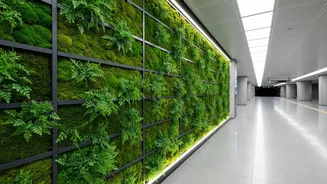
Enter the bio-engineered moss panel. This isn't simply a patch of greenery on a wall; it's a sophisticated living air filter. The concept, pioneered by companies like Germany's Green City Solutions with their 'CityTree' technology, combines specially cultivated moss species with an intelligent support structure. These panels are essentially vertical living walls of moss designed to thrive in urban conditions where they normally wouldn't survive. The term 'bio-engineered' refers less to genetically modifying the moss itself and more to the engineered ecosystem that houses it. This system provides everything the moss needs, from water to nutrients, allowing it to do what it does best: clean the air.
How Moss Captures Dust
Moss is a surprisingly effective filter due to its unique biological structure. Unlike plants with roots, mosses absorb water and nutrients directly from the air through their vast leaf surface. This surface area is incredibly large; some estimates suggest a moss's surface is 30 times its physical size. The magic happens through electrostatic attraction. Fine dust particles are often positively charged, while the surface of the moss is negatively charged, causing pollutants to stick to the leaves. Once captured, the moss doesn't just hold onto these particles. It actively metabolises a portion of them, converting pollutants into its own biomass. This natural process effectively removes harmful dust and other pollutants like nitrogen oxides from the air.
Smarter Than Your Average Green Wall
The key to making these moss panels work efficiently in a demanding environment like a metro station is the integrated technology. These are not passive panels but active, intelligent systems. Internet of Things (IoT) sensors constantly monitor the surrounding air quality, as well as the health of the moss itself, tracking humidity and temperature. This data allows the system to automatically irrigate and provide nutrients to the moss, ensuring it remains healthy and operating at peak filtering capacity. Some systems even use fans to actively pull polluted air through the moss, increasing the volume of air cleaned per hour. This combination of nature and technology creates a self-sustaining bio-filter that is far more powerful than a simple patch of moss.
Do They Really Work?
The evidence from pilot projects in cities like London, Berlin, and Paris is promising. Studies have shown that these moss installations can significantly reduce particulate matter in their immediate vicinity. For example, one 'CityTree' unit claims to have the pollution-filtering power of up to 275 conventional trees, capable of reducing particulate matter by up to 30% in its local environment. Research has verified that moss can filter fine dust by up to 82% thanks to electrostatic binding. While a single panel won't purify an entire city, placing them in pollution hotspots like metro platforms, where people spend concentrated periods of time, can create cleaner air zones where they are needed most. They are not a replacement for large-scale pollution reduction policies, but they offer a potent, localised solution.