




A Famous System Under Scrutiny
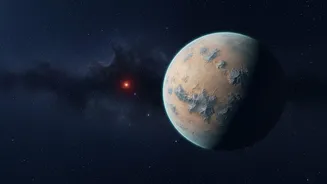
Just 40 light-years away lies one of the most intriguing planetary systems ever discovered: TRAPPIST-1. It features seven rocky, Earth-sized planets orbiting a small, cool star. This makes it a perfect natural laboratory for studying worlds outside our
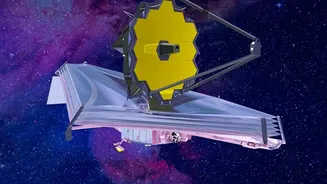
solar system. Since their discovery, scientists have been eager to learn if these planets have atmospheres, a key ingredient for potential habitability. Using the JWST, astronomers employ a technique called transmission spectroscopy. By watching a planet pass in front of its star, they can see which wavelengths of starlight are absorbed by its atmosphere, revealing the gases within.
What Are 'Heavy' Carbon Gases?
When scientists talk about 'heavy' elements in astronomy, they mean anything other than the two lightest and most common elements in the universe: hydrogen and helium. In the context of planetary atmospheres, 'heavy carbon gases' typically refer to molecules like carbon dioxide (CO2) and methane (CH4). Unlike a primary atmosphere of hydrogen and helium scooped up when a planet first forms, a secondary atmosphere containing these heavier gases is often produced by geological activity like volcanic eruptions or is delivered by comets. Finding them tells a much richer story about a planet's history and evolution.
A Tale of Two Planets
Recent JWST observations have focused on the two innermost planets, TRAPPIST-1b and TRAPPIST-1c. The findings for TRAPPIST-1b were stark: it appears to be a bare rock with no significant atmosphere. Its proximity to the star likely means any atmosphere it once had was blasted away by intense radiation. Hopes then turned to its neighbour, TRAPPIST-1c, which is roughly the size of Venus and receives a similar amount of energy. Initial theories suggested it might have a thick, Venus-like atmosphere dominated by carbon dioxide.
A Thin Veil of Carbon Dioxide
The results for TRAPPIST-1c were surprising. While JWST did find evidence consistent with the presence of carbon dioxide, it was not the thick, suffocating blanket found on Venus. Instead, the data suggests that if TRAPPIST-1c has an atmosphere, it is extremely thin—perhaps even thinner than the CO2 atmosphere on Mars. The planet’s dayside temperature was measured to be around 107 degrees Celsius, much cooler than a Venus-like world, which ruled out a runaway greenhouse effect. This landmark measurement makes TRAPPIST-1c the coolest rocky exoplanet ever to be characterized by its own heat.
Significance of a 'Failed Venus'
Discovering that TRAPPIST-1c is not a Venus twin is just as important as finding one. The lack of a thick CO2 atmosphere suggests the planet may have formed with very little water to begin with. On early Earth and Venus, vast oceans are thought to have contributed to the formation of thick atmospheres. This finding provides a crucial data point for planetary formation models. It demonstrates that not all Earth-sized planets in similar orbital positions end up with the same atmospheric fate. It's a vital piece of the puzzle for understanding the diversity of rocky worlds across the galaxy.
A Huge Leap, Not a Final Answer
While this discovery doesn't point to a habitable world on TRAPPIST-1c, it represents a monumental technological achievement. For the first time, we are able to detect and begin to characterize thin, secondary atmospheres on Earth-sized planets outside our solar system. This capability was a primary goal for the JWST. Every new observation, even those that rule out certain conditions, helps scientists refine their search for life. The focus now shifts to the other planets in the system, particularly those in the 'habitable zone' like TRAPPIST-1e, where the tools and techniques honed on its inner siblings will be applied with even greater precision.