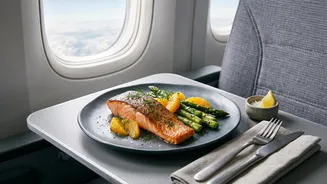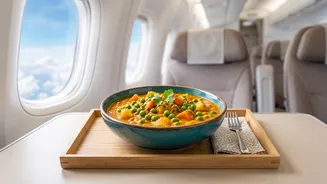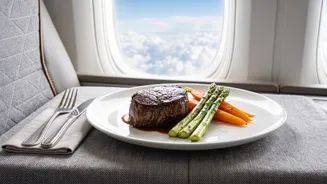







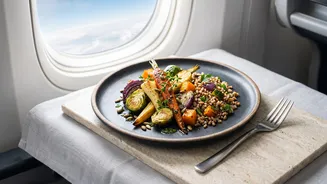
Ever wonder why food tastes bland on an airplane? It’s not just your imagination or the chef's fault. The answer lies in a fascinating interplay between your body and the environment at 30,000 feet, which significantly alters your sense of taste.
The Cabin Environment: A Perfect Storm for Taste
The common
complaint about lackluster airplane food has a strong scientific basis. It's not necessarily that the food itself is bad, but that the conditions inside an aircraft cabin create a perfect storm that dulls our ability to taste properly. When a plane is at cruising altitude, the cabin is pressurized to the equivalent of being on a mountain at 6,000 to 8,000 feet. This environment, combined with two other critical factors—extremely low humidity and constant background noise—systematically sabotages our senses of taste and smell. Studies have shown that our perception of saltiness and sweetness can drop by as much as 30 percent in these conditions.
The Pressure Problem
The first major factor is the drop in atmospheric pressure. While cabins are pressurized for safety, the air is still much thinner than at sea level. This lower pressure can slightly reduce the oxygen saturation in your blood. This state, known as mild hypoxia, can make our sensory receptors, including taste buds and olfactory cells in the nose, less sensitive. Think of it as your body's sensory equipment operating at a lower power setting. The intricate process of tasting begins when molecules in food dissolve in saliva and bind to taste receptors on the tongue. Lower pressure and the physiological changes it causes mean this entire system becomes less efficient, making it harder to register the full flavour profile of a meal.
The Dryness Factor
Perhaps the biggest culprit in taste suppression is the incredibly low humidity. The air inside a cabin at cruising altitude is exceptionally dry, often with humidity levels below 12%, which is drier than most deserts. This arid environment has a two-pronged effect. First, it dries out the mucous membranes in your nose. Since around 80% of what we perceive as 'flavour' is actually derived from our sense of smell, this is a significant blow. When your nasal passages are dry, it becomes harder for aromatic compounds from food to be detected by your olfactory receptors. Second, the dry air reduces saliva production, leading to a dry mouth. Saliva is essential for taste because it dissolves food molecules, allowing them to interact with the taste buds on your tongue. With less saliva, the signal sent to your brain is weaker.
The Unexpected Role of Noise
A surprising contributor to bland airplane food is the constant drone of the jet engines. The steady, loud hum in a cabin, typically around 85 decibels, has been shown to interfere with our ability to taste. Research from experimental psychologists has demonstrated that loud background noise can selectively suppress the perception of sweetness and saltiness. However, the same noise appears to have the opposite effect on our fifth basic taste: umami. This savoury taste, found in ingredients like tomatoes, mushrooms, and aged cheese, is often perceived as more intense in noisy environments. This phenomenon helps explain why many people who would never drink tomato juice on the ground find themselves craving it during a flight—its umami-rich profile cuts through the sensory fog.
Rethinking Food for the Skies
Understanding this science has led airlines and their caterers to completely rethink how they design in_flight menus. Simply adding more salt or sugar doesn't always work and can result in meals that would taste overly seasoned on the ground. Instead, chefs focus on compensating for the dulled senses in other ways. They often create dishes that are naturally rich in umami, using ingredients like parmesan, soy sauce, and tomato reductions to ensure the food remains flavourful at altitude. They also favour recipes with strong spices and herbs, as our perception of sour, bitter, and spicy flavours remains largely stable in flight. So, next time you are served a curry or a rich stew on a plane, know that it was likely chosen because its bold, complex flavours are robust enough to stand up to the challenging sensory environment of the cabin.