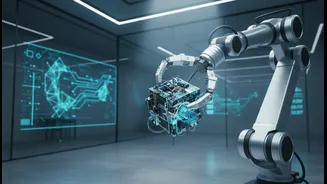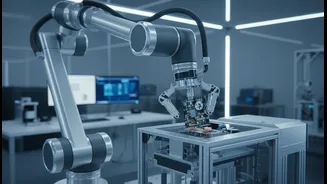








The Safety Question: What Happens When It Fails?
For AI that only exists on a screen, failure is an error message. For a physical AI operating a multi-tonne robotic arm, failure can be catastrophic. The first and most important question revolves around safety, which goes far beyond just preventing harm.
Teams must ask: What are the robot's physical and operational limits? Safety isn't just about a last-resort emergency stop button; it's about designing a system with inherent constraints. This includes defining 'safety envelopes'—virtual fences and speed limits hard-coded into the safety system, which the AI application cannot override. Another key question is how the robot communicates its intent to nearby humans. Predictability is a cornerstone of safety. Systems that use lights or sounds to signal their next move allow human coworkers to anticipate and trust them, creating a safer, more collaborative environment.
The Reliability Question: Will It Work Outside the Lab?
The gap between a robot working in a pristine lab and one functioning in a chaotic, real-world environment is massive. This is the reliability gap, and it's where most impressive demos fail in production. The critical question is: How does the system handle variability and uncertainty? A robot trained in perfect lighting can be completely blinded by a sudden glare or a dusty sensor. An AI that works on perfectly flat floors may fail on a slightly uneven surface. Developers and adopters must rigorously probe how the system adapts. Does it rely on a single camera, or does it use redundant sensors like LiDAR and radar to build a more robust picture of the world? The history of robotics is filled with systems that couldn't handle minor real-world variations. True reliability isn't about performing a task correctly once, but about performing it consistently across thousands of hours under imperfect conditions. A system needs to prove it can handle not just the task, but the messiness of reality itself.
The Control Question: Who Is Really in Charge?
Full autonomy is the ultimate goal for many, but it's not always the safest or most practical starting point. A crucial set of questions must address the spectrum of control. How can a human operator intervene, and how quickly? Is there a clear, accessible way to take manual control or command a 'safe stop' without ambiguity? This concept, sometimes called 'shared autonomy' or 'human-in-the-loop', acknowledges that the most robust systems often combine AI's speed with human judgment. Furthermore, who is liable when an autonomous decision leads to an irreversible error? This is no longer just a technical question but a risk appetite decision. Teams need to define the chain of command for the robot. When the AI is uncertain, does it stop and wait for human instruction, or does it make a best guess? Establishing clear protocols for regaining control and managing uncertainty is fundamental to deploying physical AI responsibly.
The Real-World Data Question: How Does It Actually Learn?
An AI is only as good as the data it's trained on, and for physical AI, this is the biggest bottleneck. Unlike digital AI that can learn from the vast expanse of the internet, a physical robot must learn from real-world interaction, which is slow and expensive to gather. Therefore, users and teams must ask: What is the data strategy? Is the robot learning from a simulation, and how well does that simulation reflect reality? More importantly, how does the system learn from its mistakes in the field? A truly intelligent system uses data from its operational failures to improve not just itself, but the entire fleet. This requires a secure and robust data pipeline to collect, analyse, and redeploy learnings. Without a clear strategy for continuous, real-world learning, a physical AI system remains static and will struggle to adapt to the ever-changing environment it's meant to master.