






The Solar System’s Hidden Oceans
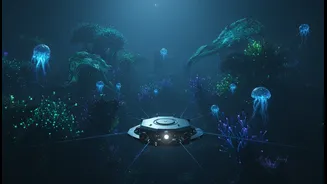
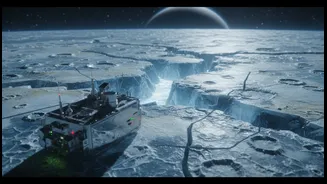
Beneath the frozen, fractured surfaces of moons like Jupiter’s Europa and Saturn’s Enceladus, scientists have strong evidence of vast, liquid water oceans. These are not just puddles; Europa’s ocean may hold more than twice the water of all of Earth’s
oceans combined. Unlike the barren, irradiated surfaces, these subsurface seas could be shielded from harsh radiation and potentially warmed by hydrothermal vents on the seafloor, similar to those on Earth that teem with life. Enceladus even offers a tantalizing shortcut: massive plumes of water vapor and ice particles from its ocean erupt into space through cracks in its surface, offering a chance to sample its seas without drilling through miles of ice. These discoveries have shifted the focus of our search for life from the dusty red plains of Mars to these dark, distant, and incredibly promising ocean worlds.
The Problem with 'Maybe'
Finding life is harder than it sounds. It’s unlikely a camera will simply spot an alien fish swimming by. Instead, scientists hunt for biosignatures—subtle clues like complex organic molecules, unusual chemical concentrations, or microscopic structures that could indicate biological processes. The trouble is, many of these signs can also be created by non-living geology or chemistry, leading to a risk of false positives. This isn't a new problem. NASA's Viking landers on Mars in the 1970s returned ambiguous results from life-detection experiments that are still debated today. With missions to ocean worlds costing billions of dollars and taking decades to plan and execute, a similarly ambiguous result would be a scientific catastrophe. The community agrees that before announcing a discovery that would change human history, the evidence must be ironclad.
A New Gold Standard for Evidence
To avoid ambiguity, astrobiologists have developed a new framework for evidence called the “Ladder of Life Detection.” Think of it as a checklist for building a convincing case. Instead of relying on a single finding, scientists must gather multiple, independent lines of evidence that all point to a biological origin. The first rung on the ladder might be detecting a potentially interesting organic molecule. But to climb higher, scientists must rule out non-biological sources, confirm the finding with different instruments, and find a pattern of evidence consistent with a living ecosystem. For example, finding complex lipids or amino acids alongside an energy source and evidence of metabolism would be far more convincing than finding one of these in isolation. This rigorous approach is designed to raise the bar for proof and move the standard from “this could be life” to “this cannot be explained by anything but life.”
One Shot, Immense Challenges
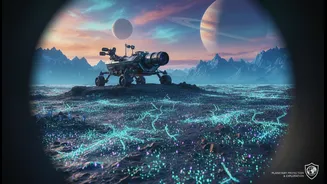
The need for such high standards is directly tied to the incredible difficulty of these missions. NASA’s Europa Clipper, which launched in October 2024 and will arrive at Jupiter in 2030, is the largest planetary science craft ever built by the agency. Its purpose isn’t even to find life, but to do the reconnaissance necessary for a future search—mapping the ice shell, confirming the ocean’s properties, and scouting for landing sites. The spacecraft must survive Jupiter’s brutal radiation environment, which is why its sensitive electronics are housed in a heavily shielded titanium vault. A future mission like the proposed Enceladus Orbilander would be even more ambitious, requiring a flight time of many years before spending over a year in orbit and then attempting a robotic landing to directly sample plume material on the surface. These are multi-generational, flagship-class endeavors. When you only get one shot, you have to be absolutely sure of your target and what you’re looking for.