
The Great Moon Race
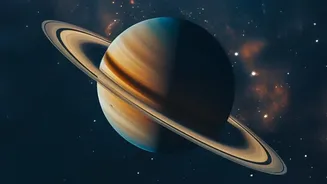
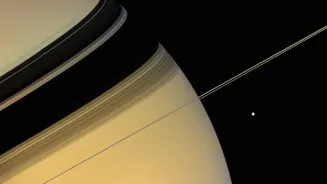
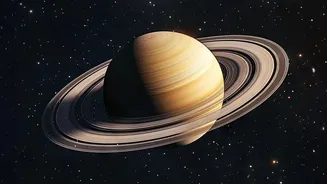
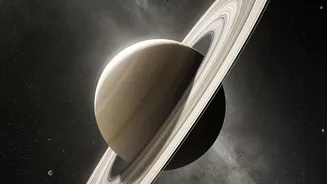
Not long ago, Jupiter held the record for the most known moons in our solar system. But in recent years, Saturn has dramatically pulled ahead. As of mid-2026, Saturn has the most confirmed moons of any planet, with a tally that has soared into the hundreds.
This back-and-forth isn't because moons are suddenly appearing out of thin air. Instead, it’s a direct result of huge leaps in telescope power and observational techniques. Astronomers can now spot incredibly faint, small objects orbiting the ringed giant that were previously invisible. Announcements from organisations like the International Astronomical Union's (IAU) Minor Planet Center have come in waves, sometimes adding dozens of newly confirmed moons at once. For instance, a massive batch of 128 moons was confirmed in March 2025, and more have been added since, cementing Saturn's lead.
How We Find New Moons
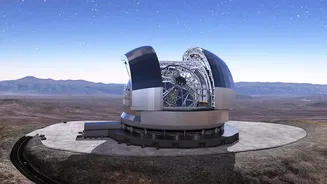
Discovering a new moon isn't a simple 'point-and-shoot' process. It requires powerful telescopes, like the Canada-France-Hawaii Telescope (CFHT), to take a series of deep-sky images over a long period. Astronomers then use a technique called 'shift and stack'. They shift the images at the same rate that a potential moon would be moving across the sky. If an object is orbiting Saturn, it will appear as a sharp point of light, while the background stars streak by. This allows them to pick out tiny, distant objects, some only a few kilometres wide. But a single sighting isn't enough. The discovery must be followed by years of additional observations to confirm that the object is truly in a stable orbit around Saturn and not just a passing asteroid. Only after its orbit is calculated and verified can it be officially designated as a new moon.
What Even Is a Moon?
This might sound like a simple question, but it’s at the heart of the fluctuating numbers. The IAU defines a moon, or natural satellite, as a celestial body that orbits a planet or smaller body. But there's a grey area. Saturn's famous rings are made of countless particles, ranging from microscopic dust to objects hundreds of metres across, each in its own orbit. At what point does a large ring particle become a tiny 'moonlet'? There is no strict size cutoff defined by the IAU. Generally, for an object to be considered a 'moon' rather than a 'moonlet', it needs to be large enough to be individually tracked and have its orbit confirmed over time. The smallest of Saturn's recently discovered moons are just a few kilometres in diameter. So, as our ability to detect smaller and smaller objects improves, the potential number of 'moons' will likely continue to grow.
A World of Irregular Shapes
Many of Saturn's newly found moons are not the perfect spheres we might imagine. The largest moons, like Titan and Rhea, are massive enough that their own gravity has pulled them into a round shape. But the vast majority of the outer moons are small, potato-shaped objects known as 'irregular satellites'. These are thought to be asteroids or comets that wandered too close to Saturn billions of years ago and were captured by its immense gravity. They tend to have large, elliptical, and inclined orbits. Many of these moons orbit in groups, suggesting they may be fragments of a larger moon that was shattered by a collision long ago. These irregulars make up the bulk of the new discoveries, and their chaotic, distant orbits make them particularly challenging to track and confirm.
A Never-Ending Discovery?
Given the ongoing advancements in technology and survey methods, it’s unlikely that we have found the 'final' number of Saturn's moons. The James Webb Space Telescope, for example, has the power to spot incredibly faint objects, potentially revealing even smaller moons in our own solar system. The current count reflects what we have been able to confirm so far. There is a theoretical limit to how many moons a planet can hold, but we are nowhere near that point. The changing number isn't a sign of confusion; it's a hallmark of active scientific discovery. Each new moon provides another clue about the formation of the Saturnian system and the chaotic early history of our solar system. From the giant, Earth-like Titan to the tiny, captured rocks on the system's fringe, each one tells a part of the story.