




Starting with a Universal Clock
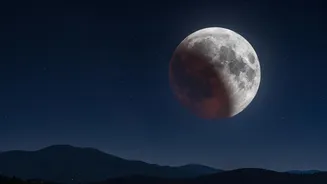
Every astronomical event, including a lunar eclipse, happens at a specific moment in time. Scientists first calculate this using a global standard called Coordinated Universal Time (UTC). The core event—when the Moon enters Earth's shadow—is a singular
occurrence. For instance, the 'greatest eclipse', or the point of maximum coverage, has one UTC timestamp. Think of this as the master prediction for the entire planet. All local calculations begin from this universal benchmark. For India, the first and most straightforward step is to convert this UTC time to Indian Standard Time (IST), which is 5 hours and 30 minutes ahead of UTC. But this is just the beginning of the journey to find your local viewing time.
Why Your Longitude Matters
India is a vast country, spanning about 30 degrees of longitude from east to west. Since the Earth rotates, this longitudinal difference has a significant impact on when you can see an event in the sky. A key factor for viewing a lunar eclipse is whether the Moon is above the horizon. For observers in the eastern parts of India, like in Arunachal Pradesh or the Andaman and Nicobar Islands, the Moon rises earlier than it does for those in the western state of Gujarat. This means that for an eclipse occurring around moonrise, people in the east might witness the beginning phases of the eclipse as the Moon is climbing into the sky, while people in the west might have to wait for the Moon to rise before they can see anything at all. In some cases, the eclipse might end before the Moon has even risen in far-western locations.
The Subtle Shift: The Parallax Effect
This is where the calculation gets really interesting and precise. It's a concept called parallax. In simple terms, parallax is the apparent shift in an object's position when viewed from two different lines of sight. You can see this for yourself: hold a finger at arm's length, close one eye, and then switch eyes. Your finger seems to 'jump' against the background. The same principle applies to viewing the Moon from different places on Earth. An observer in Delhi sees the Moon from a slightly different angle than someone in Bengaluru at the exact same moment. While this difference is tiny for an object as distant as the Moon, it is enough to affect the exact timing of when the Moon appears to enter or leave Earth's shadow. Astronomers must account for this parallax effect to provide timings accurate to the minute for a specific city.
Putting It All Together for Your City
So, how is the final timing for your city determined? It's a multi-step process. First, astronomers take the master prediction in UTC. Second, they convert it to IST. Third, they adjust for your specific geographical coordinates—your latitude and longitude. This determines the Moon's position in your local sky, including its altitude and whether it is visible at all. Finally, they apply the parallax correction based on your precise location. This fine-tuning adjusts the exact moments of 'contacts'—the points when the Moon first touches Earth's penumbra (faint outer shadow) and umbra (dark inner shadow), reaches maximum eclipse, and then exits the shadow. This detailed calculation ensures that the times you see published for your city are as accurate as possible.
The Experts Behind the Numbers
In India, these crucial calculations are handled by institutions like the Positional Astronomy Centre (PAC) in Kolkata. The PAC, part of the India Meteorological Department, is responsible for preparing official astronomical data for the country, including eclipse timings for various Indian cities. They use sophisticated models that incorporate all the factors discussed—orbital mechanics, Earth's rotation, and geographical specifics—to generate the reliable timings that a billion people rely on. Amateur astronomers and sky-gazers also use advanced software that performs these same complex calculations to plan their own viewing sessions.