




A Day Longer Than a Year?
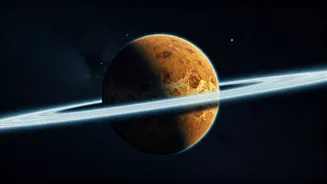
It sounds like a riddle, but it’s a planetary fact. On Earth, we have a simple rhythm: 365 days in a year. Venus throws that logic out the window. A year on Venus—the time it takes to complete one orbit around the Sun—is about 225 Earth days. But a single
day on Venus—the time it takes for the planet to complete one rotation on its axis—is a staggering 243 Earth days. Imagine the sun rising, and then not setting until months later. This means that on Venus, you could celebrate your first birthday before you’ve even lived through a single full day-night cycle. This bizarre timing is the result of Venus having the slowest rotation of any major planet in our solar system.
Spinning the Wrong Way
To make things even stranger, Venus spins backwards. Nearly every planet in our solar system, including Earth, rotates on its axis from west to east. If you were standing on the surface, you would see the Sun rise in the east and set in the west. On Venus, the opposite happens. It has what scientists call a retrograde rotation, spinning from east to west. So, not only is its day incredibly long, but the Sun also rises in the west and sets in the east. This unique combination of a slow, backward spin points to a violent and complex history, one that scientists are still working to piece together. The leading theories suggest that this wasn't the planet's original state but the result of cataclysmic events.
The Power of a Thick Atmosphere
One of the main culprits behind Venus’s leisurely spin is its own atmosphere. The Venusian air is a runaway greenhouse effect nightmare, composed almost entirely of carbon dioxide and so dense that the surface pressure is over 90 times that of Earth's—equivalent to being nearly a kilometre deep in our ocean. This super-thick atmosphere is in constant motion, whipping around the planet at speeds up to 360 km/h. This phenomenon, known as 'super-rotation', means the atmosphere circles the planet in just four Earth days. This massive, churning blanket of gas creates immense friction and tidal forces on the planet's surface. Think of it as a constant, powerful wind pushing against the entire planet, acting as a brake that has slowed its rotation down over billions of years.
Mountain Winds Altering Time
The story gets even more complex. Recent data from space probes like the European Space Agency’s Venus Express and Japan’s Akatsuki orbiter have revealed that the planet’s rotation speed isn't even constant. It actually fluctuates. The headline’s mention of “velocities” points to this discovery. Scientists found that as the high-speed winds flow over Venus's mountainous terrain, they create massive atmospheric ripples called 'gravity waves'—much like how wind creates waves in water when it flows over a rock. These waves travel up through the dense atmosphere and are powerful enough to exert a push-and-pull force on the planet itself. By transferring momentum from the fast-moving atmosphere to the solid planet, these mountain winds can slightly speed up or slow down Venus's rotation, causing the length of its day to vary by several minutes.
Echoes of an Ancient Collision
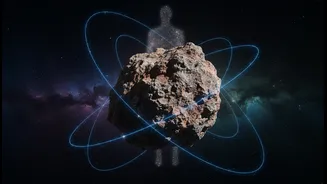
While the atmosphere explains the ongoing braking and fluctuations, it doesn’t fully explain the initial retrograde, or backward, spin. For that, many astronomers look to the chaotic early days of our solar system. The leading hypothesis is that billions of years ago, a planet-sized object—perhaps as large as Earth—slammed into a young Venus. Such a monumental impact could have been powerful enough to not only halt its original, faster rotation but completely reverse it, sending it into its current slow, backward tumble. Over eons, the atmospheric drag we see today would have further refined this motion into the state it's in now. Thus, Venus’s strange day is likely the product of two forces: a violent ancient impact and the relentless, grinding power of its own oppressive atmosphere.