






An Atmosphere Ripe for Flight
Flying on another world is incredibly difficult, as NASA’s Ingenuity helicopter demonstrated on Mars. The Martian atmosphere is 100 times thinner than Earth’s, requiring ultralight designs and high-speed rotors just to get off the ground. Titan, however,
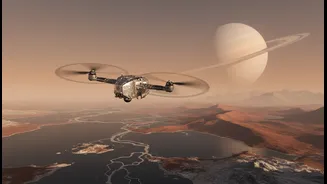
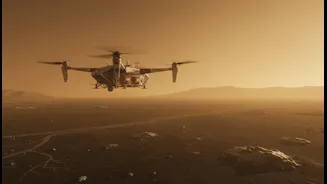
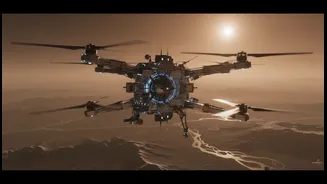
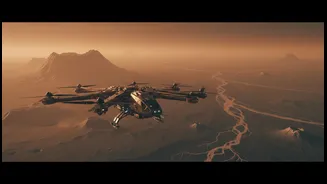
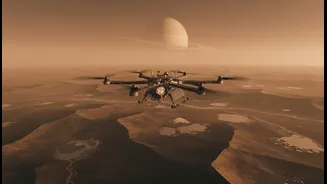
is the opposite. Its atmosphere, mostly nitrogen like Earth's, is four times denser at the surface. Combined with gravity that is just one-seventh of our own, Titan is an almost perfect place to fly. This unique environment means a heavy, car-sized vehicle like Dragonfly can operate more like a terrestrial drone, hopping across the landscape to sample dozens of locations—something a traditional rover could never do.
More Than Just a Drone
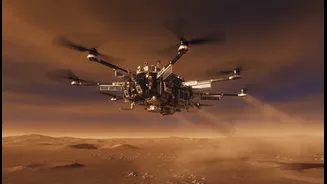
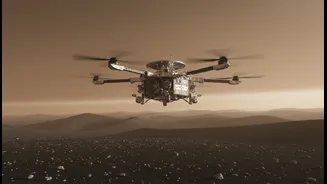
Dragonfly is a major step up from Ingenuity, which was primarily a technology demonstration. Dragonfly is a full-fledged science laboratory on wings. Scheduled to launch in July 2028 and arrive in 2034, it’s a dual-quadcopter (an octocopter) designed for stability and redundancy; it can fly even if it loses a rotor. Unlike solar-powered craft, Dragonfly runs on a Multi-Mission Radioisotope Thermoelectric Generator (MMRTG), which uses heat from decaying plutonium to generate electricity. This provides a consistent power source, allowing it to operate in Titan’s dim light and survive its frigid -179°C temperatures, while also recharging its batteries for flights that can last about 30 minutes.
The Search for Life's Building Blocks
The mission's primary goal is to study prebiotic chemistry. Titan has an active methane cycle, with methane rain, rivers, and seas, and its atmosphere is rich in complex organic molecules. These carbon-based compounds are considered the building blocks of life. Dragonfly will land in the Shangri-La dune fields near the equator and make its way toward Selk crater, a site where scientists believe liquid water from an impact melt may have mixed with these surface organics. Armed with a drill (DrACO) and a mass spectrometer (DraMS), Dragonfly will analyze the composition of the surface to understand how far prebiotic chemistry has progressed, offering a glimpse into the conditions of early Earth.
A Sobering Reality Check
Despite the ideal flying conditions, the mission is fraught with challenges. The 6-year journey to Saturn is just the beginning. With a round-trip communication delay of up to 90 minutes, Dragonfly must operate with a high degree of autonomy, making its own decisions about navigation and landing. The extreme cold requires a robust heating system, powered by the MMRTG, to keep its electronics and batteries from freezing. Furthermore, landing on unknown terrain always carries risks, though Titan’s relatively calm weather is an advantage. While the potential for discovery is immense, Dragonfly is a high-risk, high-reward endeavor pushing the boundaries of robotic exploration.