





The Sun's Hidden Temper
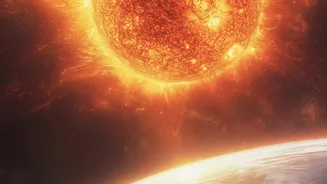
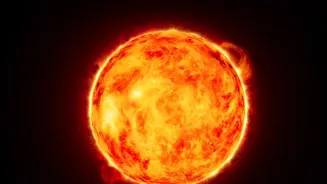
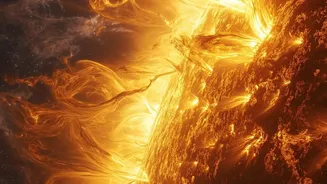
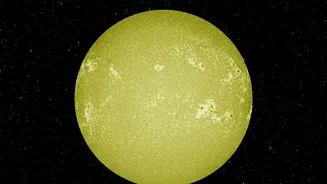
Far beyond our blue skies, the sun is a turbulent giant. It sometimes unleashes immense bursts of energy and matter known as solar storms. These events come in a few forms, primarily solar flares and coronal mass ejections (CMEs). A solar flare is an intense
explosion of radiation, while a CME is a colossal bubble of plasma and magnetic fields flung into space. When a CME is aimed at Earth, it can travel across 150 million kilometres from the sun in just a few days, and its arrival can have significant consequences. This phenomenon is called space weather, and while it can produce beautiful auroras, it also poses a serious risk to our highly technological world.
Our Ultra-Connected, Ultra-Vulnerable World
Modern life runs on systems that are highly susceptible to space weather. A powerful solar storm can disturb Earth's magnetic field and its upper atmosphere, the ionosphere. This can wreak havoc on many technologies we take for granted. Global Positioning System (GPS) signals, crucial for navigation in everything from cars to aircraft, can become inaccurate or completely lost. Radio communications, especially long-range high-frequency (HF) signals used by airlines and emergency services, can be blacked out. Satellites themselves are at risk of damage from high-energy particles, which can disrupt their electronics and degrade their orbits. Perhaps most alarmingly, strong geomagnetic storms can induce unwanted electrical currents in power grids, potentially damaging transformers and causing widespread, long-lasting blackouts.
The World's Eyes on the Sun
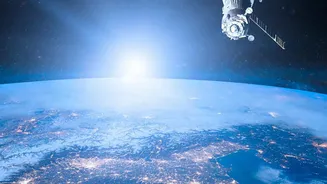
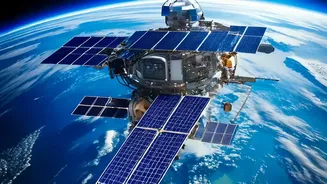
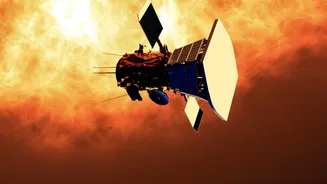
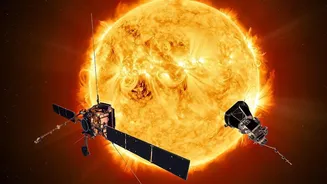
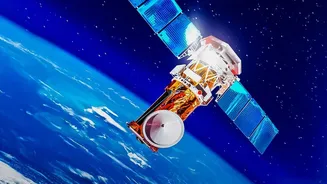
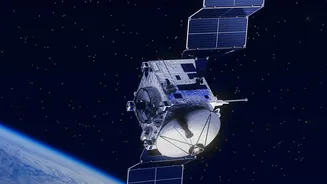
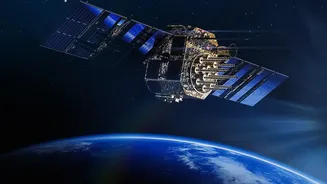
To guard against these threats, a global network of observatories constantly watches the sun. This includes both ground-based telescopes and a fleet of specialized satellites. Agencies like the U.S. National Oceanic and Atmospheric Administration's (NOAA) Space Weather Prediction Center (SWPC) act as a global hub, collecting data 24/7 to issue forecasts, watches, and warnings. Satellites like the Solar & Heliospheric Observatory (SOHO) and the Deep Space Climate Observatory (DSCOVR) are positioned in space to get an uninterrupted view of the sun, tracking for CMEs and changes in the solar wind. India has also become a key player in this international effort with its Aditya-L1 mission. Positioned at a special vantage point 1.5 million km from Earth, Aditya-L1 provides crucial data on the sun's atmosphere and the behaviour of solar storms as they travel toward us. This multi-point view helps scientists build a more complete picture of incoming threats.
From Prediction to Protection
An early warning is critical. When monitoring networks detect a threatening CME, alerts are sent out to governments and critical industries around the world. A CME can take one to three days to reach Earth, giving operators a crucial window to take protective measures. Satellite operators can put their spacecraft into a safe mode to protect sensitive electronics. Power grid managers can adjust their systems to better absorb the induced electrical currents and prevent damage to vital transformers. Airlines can reroute flights away from polar regions, where the effects of space weather are strongest and can disrupt communications and expose crew to higher radiation levels. These preemptive actions, all triggered by a space weather alert, can prevent billions of dollars in damage and ensure that critical services remain online.
Bracing for the Next 'Big One'
Scientists know it is a matter of when, not if, a truly massive solar storm will hit Earth. The benchmark for an extreme event is the 1859 Carrington Event, a solar storm so powerful it set telegraph systems on fire and created auroras visible near the equator. If a storm of that magnitude occurred today, the impact would be catastrophic, potentially crippling global supply chains, financial systems, and communication networks for months or even years. This sobering reality drives the continuous effort to improve our forecasting capabilities and build more resilient infrastructure. By studying events like the major solar storms in May 2024, where Aditya-L1 played a key role, scientists refine their models to better predict how a storm will evolve on its journey to Earth. This research is not just academic; it is essential for safeguarding the foundations of our modern, connected society against a powerful and unpredictable threat from our own star.