






The Quantum Conundrum: Powerful but Fragile
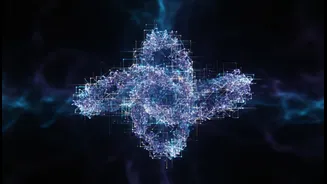
Imagine a computer that doesn't just use 0s and 1s, but a vast spectrum of possibilities in between. That's the core idea behind quantum computing. Instead of bits, it uses qubits, which can exist in a state of superposition—both 0 and 1 at the same time,
like a spinning coin. This property, along with another called entanglement, allows quantum computers to explore a massive number of potential solutions to a problem simultaneously. The catch is that this quantum state is extraordinarily fragile. The slightest disturbance—a tiny change in temperature, a stray magnetic field, or even cosmic rays—can cause a qubit to lose its information, a process called decoherence. This sensitivity leads to high error rates, making it difficult to run any calculation long enough to get a useful answer.
The Old Way of Fighting Errors
For years, the main strategy to combat this has been quantum error correction (QEC). The basic idea is to use redundancy: encode the information of one ideal 'logical qubit' across many less-reliable physical qubits. By constantly checking these physical qubits for tell-tale signs of errors (without directly measuring and destroying the quantum state), a system can detect and correct mistakes. However, this approach has enormous overhead. Early estimates suggested it could take around 1,000 physical qubits to create a single, stable logical qubit. Worse, the very process of error correction can sometimes introduce more errors than it fixes, especially if the underlying hardware isn't stable enough.
Enter the AI-Powered Mechanic
This is where reinforcement learning (RL) comes in. RL is a type of machine learning where an AI 'agent' learns by doing. It interacts with an environment, takes actions, and receives a reward or penalty based on the outcome, gradually teaching itself the best strategy over time—much like a person learning to ride a bike through trial and error. In the context of a quantum computer, the RL agent's job is to act as a tireless, incredibly precise mechanic. It observes the error signals the system naturally produces and learns to adjust the computer's many control parameters in real time. Instead of relying on a pre-written, fixed set of rules for error correction, the AI develops its own adaptive strategy.
A Breakthrough in Real-Time Calibration
Recent research from teams at Google Quantum AI and DeepMind has shown this approach isn't just a theory. In a paper published in the journal Nature, researchers demonstrated how an RL agent could continuously calibrate a quantum processor while it was running. This is a huge shift from the traditional method, which required pausing computations for disruptive and time-consuming recalibration routines. The AI agent was tasked with managing over 1,000 different control settings on Google's "Willow" quantum processor. By constantly learning from the error signals, it significantly improved the stability of the logical qubits, cutting the logical error rate by an additional 20% even after the system had already been tuned by human experts.
Why This Matters for the Future
This AI-driven, on-the-fly tuning makes quantum computers more robust and reliable. It represents a significant step toward 'fault-tolerant' quantum computing—the ability to run long, complex calculations that could one day break modern encryption, design new life-saving drugs, or discover novel materials. By using RL, researchers can make their error correction codes more efficient and adaptive to the specific noise and drift of real-world hardware. This doesn't mean we'll have a desktop quantum computer tomorrow. But it does solve a major bottleneck, making the hardware more stable and bringing the timeline for a practically useful quantum computer into sharper focus.