


A Toaster That Breathes
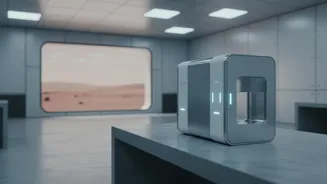
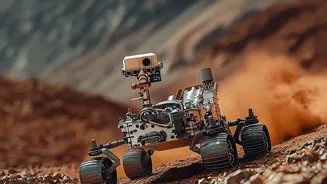
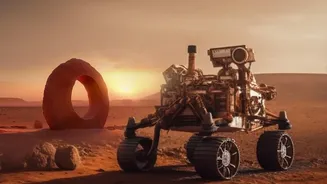
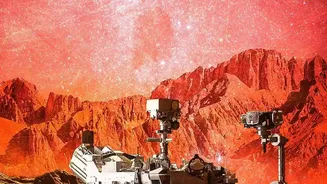
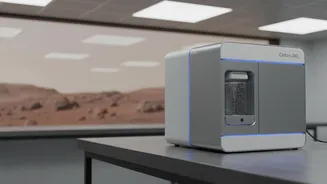
On the red plains of Mars, a small, toaster-sized box aboard NASA’s Perseverance rover has been quietly making history. Known as the Mars Oxygen In-Situ Resource Utilization Experiment, or MOXIE, this device has successfully achieved what was once science
fiction: producing oxygen from the thin, carbon dioxide-rich Martian atmosphere. Using a process called solid oxide electrolysis, MOXIE heats Martian air to around 800 degrees Celsius and splits the CO2 molecules into oxygen and carbon monoxide. Between 2021 and 2023, it completed 16 successful runs, generating about 122 grams of oxygen in total – enough to keep a small dog alive for ten hours. This achievement is a landmark proof-of-concept, demonstrating that future explorers can, in principle, 'live off the land'.
The Immense Challenge of Scale
While MOXIE’s success is a monumental first step, its output is minuscule compared to the needs of a human mission. At its peak, MOXIE produced about 12 grams of oxygen per hour, roughly the rate of a single tree. But astronauts need oxygen for more than just breathing. The single biggest consumer of oxygen on Mars will be the rocket needed to get them home. A crew of four would require about 25 metric tons of liquid oxygen to serve as the propellant oxidizer for a Mars Ascent Vehicle. To produce that amount, a future system would need to generate oxygen at a rate of 2 to 3 kilograms per hour—several hundred times more than MOXIE. The current experiment is a brilliant prototype, but it is not designed for the continuous, high-volume work required to support a human outpost.
Why MOXIE 2.0 Won't Be Enough
Simply building a bigger MOXIE isn't the answer. The current design faces significant hurdles when scaled up. For one, the high operating temperature of 800°C puts immense stress on the materials, especially during the constant start-up and shut-down cycles MOXIE endures. A full-scale plant would need to run continuously for thousands of hours, and material degradation is a serious concern. Efficiency is another issue. MOXIE is only about 10% efficient in converting electrical power into chemical energy. A larger system must be far more efficient to be practical, likely needing its own dedicated power source like a small nuclear reactor. These limitations are why the next generation of Martian oxygen factories will require fundamental upgrades in design and technology.
Designing a Martian Workhorse
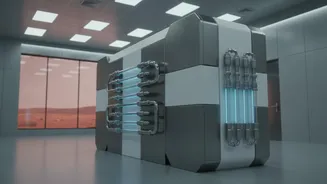
Engineers are already exploring what these 'upgraded' reactors will look like. One promising avenue is developing systems that can operate at lower temperatures, which would reduce material stress and improve longevity. Research into new materials for the electrolyzer, such as different ceramics and metal alloys, aims to create components that can withstand the harsh Martian environment for prolonged periods. Another innovative approach involves plasma technology, which researchers believe could be up to 30 times faster than MOXIE's electrolysis method and use only a fraction of the energy. Other concepts focus on electrolyzing the salty water (brine) believed to exist beneath the Martian surface. This would not only produce oxygen but also hydrogen, a valuable rocket fuel, potentially offering a two-for-one solution.
Fueling the Return Journey
Ultimately, the drive to scale up oxygen production is less about breathable air and more about providing a ticket home. Transporting the 25 tons of oxygen needed for a return rocket from Earth is logistically daunting and prohibitively expensive. Each ton of payload landed on Mars requires launching many more tons from Earth. The ability to manufacture propellant on-site through In-Situ Resource Utilization (ISRU) radically changes the economics and feasibility of human exploration. It is the critical enabler that transforms Mars from a place we can visit to a place we can stay and, crucially, from which we can return. These upgraded electrolysis reactors are not just a piece of equipment; they are the key to a sustainable, long-term human presence on another world.