





A Famous Dot, Much Closer to Home
The phrase "little red dot" holds a special place in modern astronomy. It echoes the 2016 "Pale Red Dot" campaign, a project that confirmed the existence of Proxima Centauri b, the closest exoplanet to our solar system. That 'dot' was a planet orbiting
our nearest stellar neighbour, Proxima Centauri, a red dwarf star. The discovery was monumental, giving humanity its first potentially habitable world just next door, cosmically speaking. It was found by observing the star's slight wobble, a tell-tale sign of a planet's gravitational tug. The name was a nod to Carl Sagan's famous "Pale Blue Dot" image of Earth, repurposed for a world bathed in the reddish light of its star. This discovery set a precedent: a faint, reddish signal could signify a world of possibilities. Now, the same term is being applied to objects on a vastly different scale.
Webb's Gaze into the Cosmic Dawn
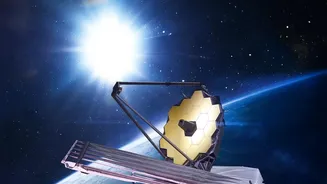
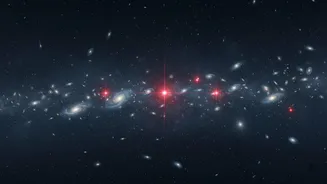
Enter the James Webb Space Telescope. With its unparalleled infrared vision, it was designed to peer back to the universe's infancy. In recent years, it has started identifying a mysterious new class of objects: extremely distant, compact, and very red sources that scientists have nicknamed "little red dots" (LRDs). These are not nearby planets. They are ancient objects whose light has travelled for over 12 billion years to reach us. One of the most famous examples is JADES-GS-z14-0, which for a time held the record as the most distant galaxy ever confirmed. We see it as it was just 290 million years after the Big Bang. To Webb's powerful camera, this fledgling galaxy, blazing with the light of young stars, appears as a tiny, reddish smudge—a little red dot from the dawn of time.
Why Red Means 'Very, Very Far'
In cosmology, red is the colour of distance. As the universe expands, it stretches the light travelling through it. Light from the most distant objects has been travelling for billions of years, and over that time, its wavelength gets stretched from shorter, bluer light into longer, redder light. This phenomenon is called redshift. The redder an object appears, the farther away it is, and the further back in time we are seeing it. The little red dots discovered by Webb, including galaxies like JADES-GS-z14-0, have an extremely high redshift, confirming they are relics from the universe's first few hundred million years. Their redness tells a story not of their actual colour, but of their incredible distance and ancient origins.
A New Cosmic Mystery
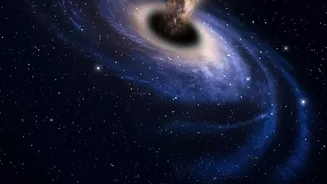
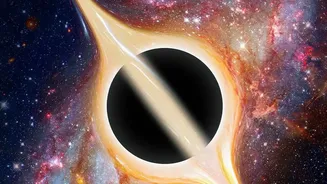
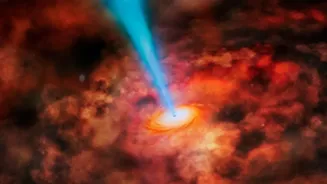
The discovery of these LRDs has opened a fascinating new puzzle for astronomers. While some, like JADES-GS-z14-0, are confirmed as early galaxies, the nature of many other little red dots remains a mystery. One leading theory is that they are the hyperactive cores of young galaxies, powered by supermassive black holes gobbling up matter at a furious pace. However, they don't behave exactly like the active galactic nuclei we see in the universe today. Recent research has even raised the possibility that some LRDs are not galaxies at all, but the visible cores of much larger systems whose fainter structures are hidden from view by the immense distance. Scientists are now embarking on a new phase of research, using Webb's spectrographs to dissect the light from these dots, searching for clues about their chemical composition, mass, and what is powering them.