







What Are Cosmic Lighthouses?
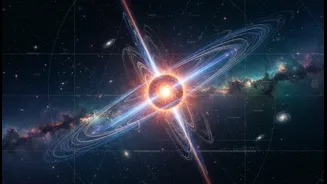
Pulsars are one of the universe's most fascinating creations. They are rapidly spinning neutron stars, the incredibly dense, city-sized remnants of massive stars that have exploded as supernovae. These stellar cores spin at astonishing speeds, some hundreds
of times per second. As they rotate, they emit powerful beams of radiation, including X-rays, from their magnetic poles. If one of these beams sweeps across Earth's line of sight, astronomers detect a regular pulse of energy. This effect is much like a lighthouse, whose rotating beam appears as a periodic flash of light to a distant ship. It is this clock-like regularity that makes certain types of pulsars, especially millisecond pulsars, incredibly valuable. Their timing stability can rival that of atomic clocks on Earth.
From Pulsars to a Galactic Map
The idea, formally known as X-ray pulsar-based navigation and timing (XNAV), is to use these natural clocks to determine a spacecraft's position autonomously. NASA's SEXTANT (Station Explorer for X-ray Timing and Navigation Technology) experiment, conducted aboard the International Space Station using the NICER X-ray telescope, has already proven the concept is viable. The system works by measuring the precise arrival times of X-ray signals from at least three different pulsars. Since each pulsar has a unique, predictable signal, a spacecraft can compare the observed arrival time of a pulse with its expected arrival time at a known reference point, like the center of our solar system. By triangulating the tiny differences in these arrival times from multiple pulsars, the spacecraft can calculate its own position in three-dimensional space, creating a self-sufficient navigation system far from Earth.
A New Toolkit for Astronomy
The primary benefit of a pulsar map is autonomous navigation for deep-space missions. Currently, spacecraft rely on NASA's Deep Space Network (DSN), a system of large radio antennas on Earth, to determine their position. This process is time-consuming and depends on constant communication with Earth, which becomes impractical for missions to Mars and beyond. XNAV would allow spacecraft to navigate independently, reducing the strain on the DSN and enabling more ambitious exploration. Beyond navigation, the same precise timing data has profound implications for X-ray astronomy and fundamental physics. Instruments like NICER are designed to probe the interior composition of neutron stars, helping scientists understand the exotic states of matter that exist under extreme density and pressure. Precise pulsar timing can also be used to test theories of general relativity and potentially detect gravitational waves.
Modeling the Universe's Extremes
Pulsars are natural laboratories for studying physics that cannot be replicated on Earth. The immense gravity and powerful magnetic fields of neutron stars create some of the most extreme environments in the cosmos. By studying the X-ray emissions from these objects with high precision, scientists can build better models of how matter behaves at ultra-high densities. For example, NICER's observations of pulsars have already provided the first-ever surface map of a pulsar and precise measurements of its size and mass. This data helps constrain theoretical models of neutron star interiors. Furthermore, discoveries made with NICER have shown that giant radio pulses from pulsars like the one in the Crab Nebula are accompanied by surges in X-ray emissions, indicating that these events are far more energetic than previously thought. This synergy between radio and X-ray astronomy deepens our understanding of the powerful engines driving these cosmic phenomena.
Reality Check: The Challenges Ahead
While the potential is enormous, creating a reliable and practical pulsar navigation system is not without its challenges. The X-ray signals from pulsars are incredibly faint, requiring large and highly sensitive detectors to capture enough photons for an accurate position fix. While X-ray telescopes are more compact than the giant radio dishes needed for similar measurements, they still represent a significant technical hurdle. An early SEXTANT demonstration determined the position of the ISS to within a few kilometers, but this required significant observation time. Improving this accuracy, especially for fast-moving spacecraft in deep space, will require more advanced algorithms and a comprehensive, stable catalog of well-timed pulsars. Therefore, it's not a replacement for Earth-based systems like GPS but rather a complementary technology for autonomous navigation in the vast emptiness where no ground support is available.