




A Planet of Paradoxes
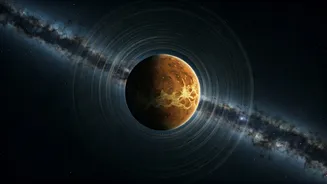
To grasp this cosmic oddity, let's talk numbers. A year on Venus, the time it takes to complete one orbit around the Sun, is about 225 Earth days. [6, 9] A single day on Venus, however, is defined by its rotation on its own axis, which takes a staggering
243 Earth days. [2, 6] This means that on our nearest planetary neighbour, a day is nearly 20 Earth days longer than its year. [3, 14] Adding to the strangeness, Venus spins backward compared to Earth and most other planets in the solar system. [3, 6] This retrograde rotation means that if you could stand on its scorching surface, you would see the Sun rise in the west and set in the east. [3, 7]
The Atmosphere as a Powerful Brake
One of the leading theories behind Venus's slow spin lies in its incredibly dense atmosphere. [11] With a surface pressure over 90 times that of Earth's, Venus's atmosphere is a powerful, integrated part of the planet. [2, 3] This thick blanket of gas is believed to exert a significant drag on the planet's surface. [11, 16] As the Sun heats the atmosphere, it creates strong thermal tides—think of them as atmospheric waves—that flow around the planet. These powerful, circulating winds push against the solid surface, acting like a planetary-scale brake that has slowed Venus's rotation over billions of years. [12, 13] This atmospheric drag is so powerful it may have prevented the Sun's gravity from tidally locking the planet, a state where one side would permanently face the Sun. [11]
A Violent, Cataclysmic Past
Another compelling theory suggests a more dramatic event in Venus's early history: a colossal impact. [8, 10] In the chaotic early days of the solar system, collisions between large objects were common. Some scientists propose that Venus was struck by a massive, planet-sized object. [7, 10] Such a high-velocity impact could have been powerful enough to not only dramatically slow the planet's initial, likely faster, rotation but could have even flipped it upside down, resulting in the retrograde spin we observe today. [4, 12] While a giant impact is a plausible explanation for both the slow speed and backward direction, the exact role it played compared to long-term atmospheric effects is still a topic of active research and debate among planetary scientists. [8, 20]
What a Long Day Means for Venus
This incredibly slow rotation has profound consequences for the planet. While one might expect extreme temperature differences between a day side basking in sunlight for months and a night side plunged in darkness, Venus's thick atmosphere prevents this. [1, 21] The dense blanket of carbon dioxide is incredibly effective at trapping and circulating heat, resulting in a runaway greenhouse effect. [11] This ensures that surface temperatures remain shockingly uniform, hovering around 465 degrees Celsius, hot enough to melt lead, across the entire planet, day or night. [18, 21] The sunrise-to-sunrise cycle, or a solar day, is actually shorter than the rotational day, lasting about 117 Earth days because the planet is also moving in its orbit around the Sun. [6, 7] This means the sun rises only twice during each Venusian year. [6, 9]