

The Ultimate Insurance Policy
In the high-stakes world of rocketry, things can go wrong in a fraction of a second. The Crew Escape System (CES) is the astronauts' ultimate insurance policy. It functions much like a hyper-advanced ejection seat in a fighter jet, designed to pull the entire
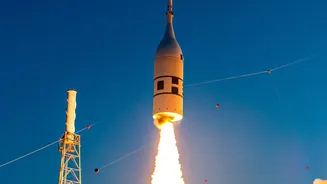
crew module away from a failing rocket. This system is engineered to activate automatically within milliseconds of a detected anomaly, whether the rocket is still on the launchpad or hurtling through the atmosphere at supersonic speeds. The goal is simple: get the crew clear of danger. The CES uses a series of powerful, quick-acting solid rocket motors to generate immense thrust, pulling the capsule upwards and away from the booster with an acceleration greater than the launch vehicle itself.
Simulating a Launchpad Emergency
One of the first critical hurdles is the Pad Abort Test (PAT). This test simulates a worst-case scenario where an emergency occurs before or during ignition on the launchpad. For this test, there is no massive rocket; the crew module and its attached escape system are placed directly on the pad. On command, the escape motors fire, launching the capsule into the air to a safe altitude and distance before parachutes deploy for a gentle landing. ISRO successfully conducted its first PAT in 2018, where a 12.6-tonne simulated crew module was lifted to an altitude of 2.7 km before splashing down safely in the Bay of Bengal. This test proved the system could effectively save the crew even with zero forward speed and zero altitude, a crucial first step in validating the entire escape sequence.
The High-Altitude Challenge: TV-D1
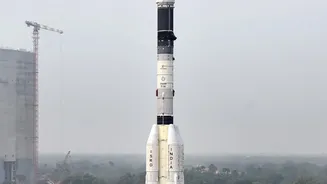
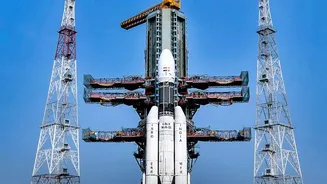
An emergency on the pad is one thing; an anomaly while speeding through the sky is another. This is where high-altitude abort tests come in. In October 2023, ISRO conducted the Test Vehicle Abort Mission-1 (TV-D1). This mission used a specially designed single-stage liquid-fueled rocket to carry a full-scale unpressurised crew module to a specific altitude and speed. The objective was to simulate an abort during the most challenging phase of atmospheric flight—transonic speed, or around Mach 1.2—where the aerodynamic forces on the vehicle are at their peak. At an altitude of about 17 km, the abort sequence was deliberately triggered. The escape motors fired, pulling the crew module away from the test vehicle as planned.
From Separation to Splashdown
The success of the TV-D1 mission went beyond just the firing of the escape motors. After the powerful pull, the Crew Escape System separated from the Crew Module. The module then began its descent, deploying a series of parachutes to slow down. Drogue parachutes deployed first to stabilize the capsule, followed by the main parachutes, ensuring a soft touchdown in the sea, about 10 km off the coast of Sriharikota. The entire sequence, from launch to the successful recovery of the crew module by the Indian Navy, was a comprehensive validation of the end-to-end abort procedure. The mission demonstrated the performance of the escape system, the separation mechanisms, and the parachute deceleration system.
Building Confidence, One Test at a Time
The TV-D1 mission was the first of four planned abort tests designed to qualify the Crew Escape System across different flight scenarios before any astronaut boards the Gaganyaan capsule. Future tests will expand the validated abort envelope, ensuring the system can perform flawlessly under various conditions and altitudes. ISRO's approach involves a methodical, step-by-step process of testing every conceivable failure mode. This includes static fire tests of the escape motors on the ground, the Pad Abort Test, and a series of in-flight abort demonstrations. This rigorous testing is complemented by uncrewed orbital flights of the full Gaganyaan system before the final crewed mission, which is targeted for 2026. Each successful test builds another layer of confidence, proving that the systems designed to protect India's astronauts are robust, reliable, and ready for any eventuality.