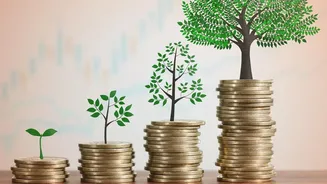








The Slow, Underwhelming Start
The magic of compounding is that you earn returns not just on your original investment (the principal), but also on the accumulated interest or gains from previous periods. In simple terms, it’s 'interest on interest'. For example, if you invest ₹10,000
at a 10% annual return, you earn ₹1,000 in the first year, making your total ₹11,000. In the second year, you earn 10% on ₹11,000, which is ₹1,100. That extra ₹100 is your first taste of compounding. However, in these initial stages, the base amount is small, so the growth feels almost invisible. This slow start is where many investors lose faith, as the process feels more like a crawl than a sprint. Your own contributions make up the bulk of your portfolio's growth, while the compounding effect is just a tiny, quiet partner.
The Snowball Down the Hill
A popular analogy for compounding is a snowball rolling down a long hill. At the top, it’s tiny and picks up very little snow with each rotation. For a long time, it remains small. This is like the early years of investing. But as the snowball grows larger, its surface area increases, and it starts gathering more and more snow with every turn. Eventually, it becomes a massive, unstoppable force. This is the inflection point in your investment journey. The growth stops being linear (adding a fixed amount) and becomes exponential (multiplying). The returns generated by your portfolio start to become so significant that they eventually dwarf your regular contributions. The growth starts feeding itself in a powerful feedback loop.
The Mathematics of the 'Hockey Stick' Curve
The visual representation of compound growth is often called a 'hockey stick' curve because it stays flat for a long time before dramatically turning upward. This isn't a fluke; it's pure mathematics. Let's look at a hypothetical investment. After 10 years, your investment might double. But it won't take another 10 years to double again; it might only take seven. And the next doubling could happen in just five years. This acceleration is a core feature of exponential growth. A useful shortcut to understand this is the 'Rule of 72'. By dividing 72 by your annual rate of return, you can estimate how many years it will take for your money to double. For example, at a 9% annual return, your money would double in approximately eight years (72 ÷ 9 = 8). It would quadruple in 16 years and grow eightfold in 24 years. This shows how the bulk of accumulation is concentrated in the later periods.
Why Patience Is the Most Important Ingredient
Understanding the math is one thing, but enduring the slow years is a psychological challenge. Investor psychology is often the biggest hurdle to harnessing compounding. Emotions like fear and greed can lead people to make impulsive decisions, such as panic-selling during downturns or chasing hot stocks, both of which interrupt the compounding process. The early years feel boring and can lead to frustration when you compare your small gains to dramatic market stories. However, the real challenge is not knowing that compounding works, but staying invested long enough for it to matter. Those who abandon their strategy before the growth curve bends upwards miss out on the most powerful phase of wealth creation. The explosive final years are the reward for discipline and patience during the long, quiet beginning.