




An Orbit Choked with Junk
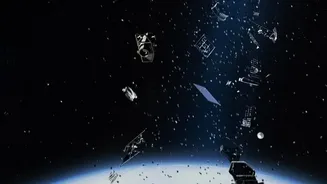
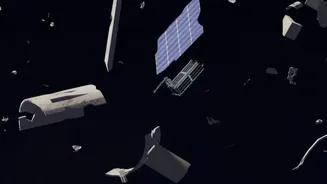
Since the launch of Sputnik in 1957, humanity has placed thousands of satellites into orbit. While many are active, a huge number are now just high-speed junk. This debris includes everything from entire dead satellites and spent rocket stages to tiny
flecks of paint and metal fragments from explosions or collisions. Travelling at speeds up to 28,000 km/h, even a pinhead-sized object carries enough kinetic energy to cripple an operational satellite, a spacecraft, or the International Space Station. Experts warn of the Kessler Syndrome, a theoretical tipping point where collisions create a cascading chain reaction of debris, potentially rendering parts of orbit unusable for generations. The threat is most severe in Low Earth Orbit (LEO), an orbital band that is home to a majority of satellites, including critical infrastructure for communications and Earth observation.
The Space Janitors: Harpoons, Nets, and Claws
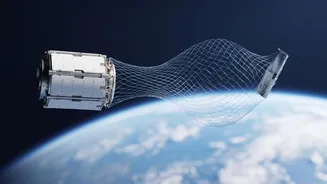
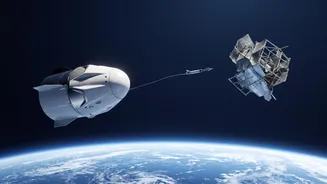
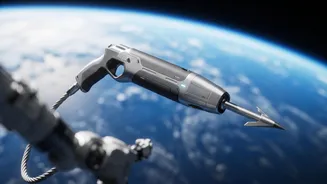
To combat this growing problem, space agencies and private companies are developing a range of remarkable 'Active Debris Removal' (ADR) technologies. These methods involve a 'chaser' spacecraft designed to hunt down, capture, and de-orbit a specific piece of junk. One of the leading concepts is direct capture. The Swiss startup ClearSpace, commissioned by the European Space Agency (ESA), is developing the ClearSpace-1 mission. This spacecraft will use a set of four robotic arms to essentially 'hug' a piece of debris—in this case, an old ESA satellite named PROBA-1—and then drag it down into Earth's atmosphere where both will burn up. Other direct-contact methods being tested include firing a harpoon to spear a target or casting a giant net to envelop it. These 'hunter' methods are ideal for removing large, high-risk objects like defunct satellites.
Magnetic Tugs and Robotic Arms
Another major player is the Japanese company Astroscale, which is developing solutions for a more sustainable space environment. Their ELSA-M servicer is designed for commercial clients, aiming to capture and deorbit multiple satellites in a single mission. It will use a magnetic docking mechanism, where future satellites are equipped with a standardized plate that the servicer can easily latch onto. This approach is part of a broader push for 'in-orbit servicing,' which includes not just removal but also life extension services like refueling. For debris that wasn't designed to be captured, companies are also developing sophisticated robotic arms with advanced AI, guidance, and navigation to autonomously approach and grapple tumbling, uncooperative objects. Missions from companies like Astroscale and ClearSpace are expected to provide crucial demonstrations of these technologies in the coming years, with launches planned around 2028.
Contactless Solutions: Lasers and Dragsails
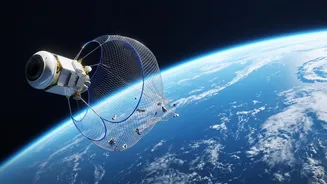
Not all cleanup methods require physical contact. Researchers are exploring contactless approaches that could be safer for certain scenarios. One promising technology involves using powerful, ground-based lasers to gently nudge debris. The laser beam ablates a tiny amount of the object's surface, creating a small plume of gas that acts like a micro-thruster, altering the object's trajectory and causing it to fall out of orbit more quickly. This method is being investigated for clearing smaller, more numerous pieces of debris. Another, more passive approach involves 'dragsails.' These are large, lightweight sails that can be attached to a satellite. At the end of its mission, the sail deploys, dramatically increasing the satellite's atmospheric drag and significantly speeding up its orbital decay, ensuring it re-enters and burns up in a controlled manner.