
The Moon's Two Faces
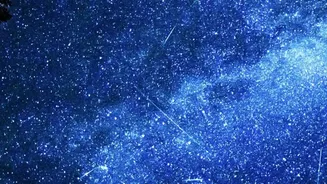
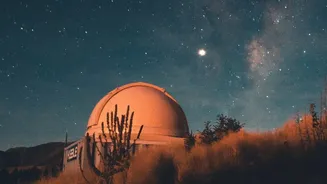
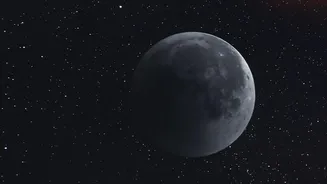
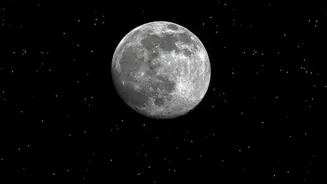
September offers two key lunar events for skywatchers. The first is the New Moon on September 11-12. This is when the Moon is invisible, creating the darkest skies of the month. It’s the perfect opportunity for stargazers to head away from city lights
and gaze upon the Milky Way. For observers in the Northern Hemisphere, this is one of the last chances to see the galaxy's bright core before it disappears from evening skies until next spring. Then, on the night of September 26, look for the beautiful Full Harvest Moon. This is the full moon closest to the autumnal equinox, and it was traditionally a beacon for farmers gathering their crops. Watch it rise in the east around sunset, where it may appear larger and more golden than usual due to a clever optical trick called the Moon illusion. As a bonus, the planet Saturn will be a bright companion, following the Moon across the sky throughout the night.
Venus Shines Brightest
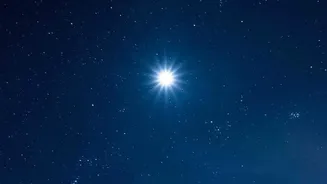
The undisputed star of the evening sky this month is Venus. Often called the 'Evening Star', it will be impossible to miss as a dazzlingly bright beacon in the western sky shortly after sunset. Around September 18-22, Venus reaches its peak brilliance for the entire year, shining at a stunning magnitude of -4.8. Interestingly, if you were to look at it through a telescope during this time, you would see it as a slender crescent, proving that brightness isn’t just about how much of its face is lit. On September 14, observers across much of Asia and Europe will have a chance to witness a rare event: a lunar occultation, where the crescent Moon passes directly in front of Venus, hiding it for about an hour. This may be visible in daylight with binoculars or a small telescope if you know where to look.
A Morning Dance of Planets
If you're an early riser, you're in for a treat. The pre-dawn hours host a quiet parade of planets in the eastern sky. Mars, though still relatively faint, will be climbing higher each morning. The best time to spot it will be on September 6 and 7, when a slim crescent Moon will pass very close by, acting as a perfect guidepost. Just a day later, on the morning of September 8, the Moon continues its journey to meet up with the giant planet Jupiter. This celestial trio—Moon, Mars, and Jupiter—will create a lovely scene for anyone looking east before sunrise, offering a great photo opportunity.
A Quest to the Edge of the Solar System
For those with a pair of good binoculars or a telescope, September 25-26 offers a unique challenge: spotting Neptune. The most distant planet in our solar system will be at opposition, meaning Earth is passing directly between it and the Sun. This is when Neptune is at its closest and brightest for the year. But don't expect to see a giant blue ball; at 4.5 billion kilometres away, Neptune will appear as a tiny, faint, star-like point of blue light even with optical aid. It will be in the constellation Pisces, visible all night long, rising at sunset and setting at sunrise. Finding it is a rewarding experience, a true testament to the vastness of our cosmic neighbourhood.
The Celestial Turning Point
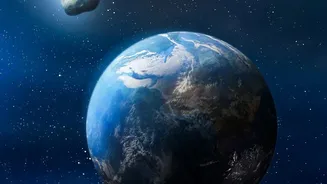
Finally, September marks a significant seasonal milestone. On September 22 or 23, depending on your time zone, Earth will experience the September Equinox. This is the astronomical start of autumn in the Northern Hemisphere and spring in the Southern Hemisphere. On this day, the Sun shines directly on the equator, and day and night are of roughly equal length all across the globe. While it’s not a visual event you can 'watch' in the sky, it's a fundamental moment in Earth's yearly journey around the Sun that governs our seasons. It’s also known to be a good time to spot auroras near the poles.