



A Sweet Discovery in the Stars
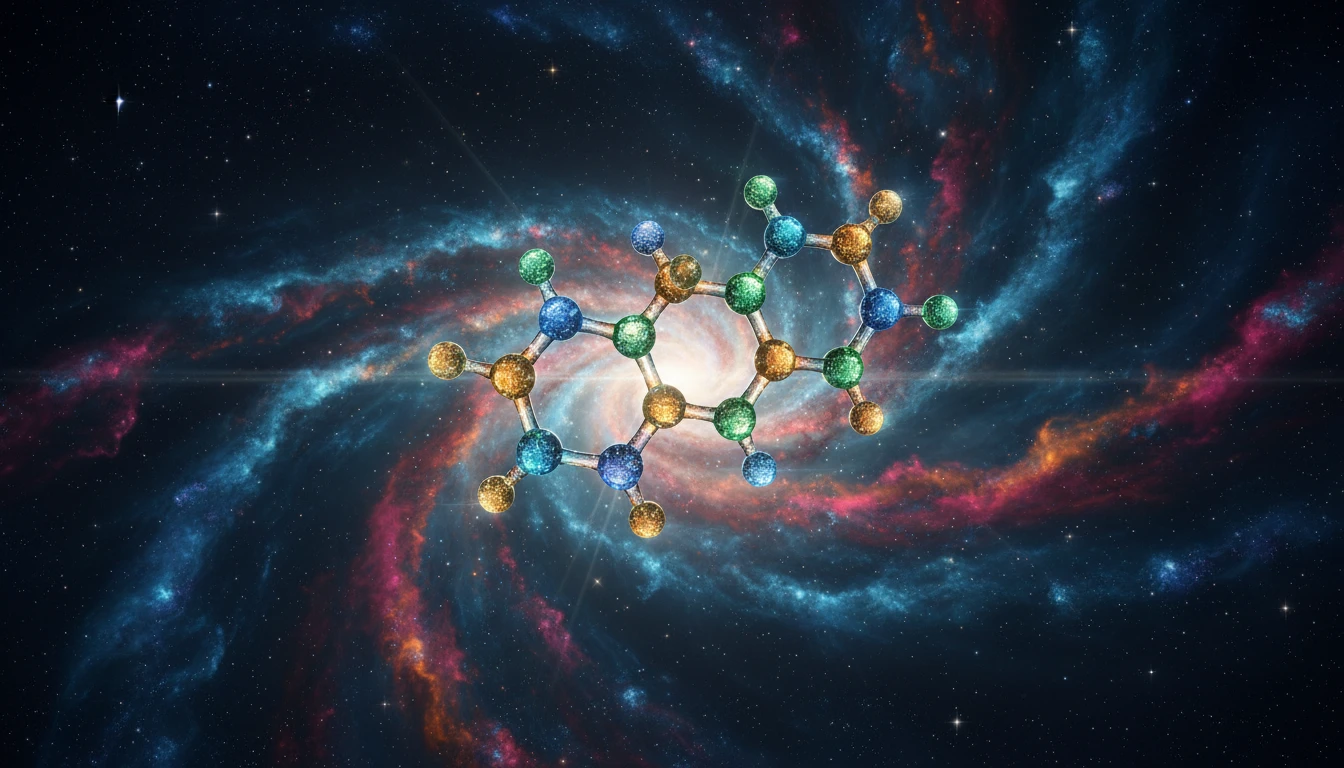
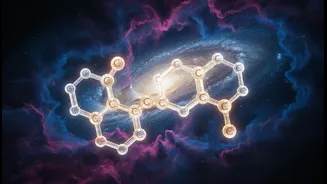
An international team of researchers has, for the first time, detected a true sugar molecule in interstellar space. Using two powerful radio telescopes in Spain, they identified the chemical signature of erythrulose, a four-carbon sugar, swirling in a molecular
cloud some 27,000 light-years from Earth. While other sugar-related molecules and even true sugars in meteorites have been found before, this is the first time a sugar has been spotted directly in the cold, diffuse space between stars. Erythrulose is the largest non-cyclic molecule yet identified in the interstellar medium. Its detection was a surprise, challenging long-held assumptions about how complex molecules form in the universe and providing a critical clue in the story of our own origins.
The Galactic Center's Chemical Factory
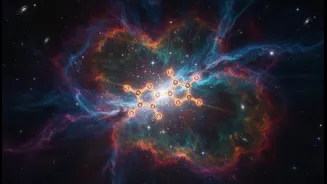
The sugar was found in a region known as G+0.693-0.027, a giant molecular cloud near the center of the Milky Way. These clouds are cosmic nurseries where stars and planets are born. They are also surprisingly effective chemical factories. Despite frigid temperatures hovering around -250°C, the surfaces of icy dust grains act as microscopic assembly lines. Here, simpler atoms and molecules can stick together and react over millions of years, building ever more complex structures. The detection was made by analysing 12 distinct radio signals from the cloud that precisely matched the spectral fingerprint of erythrulose measured in a lab. This confirmed its presence in one of the richest chemical environments in our galaxy.
A New Recipe for Life's Ingredients
One of the most puzzling questions about the origin of life is where the first sugars came from. They are essential, forming the backbone of RNA and DNA and providing energy for metabolic processes. However, experiments simulating the conditions of early Earth have consistently failed to produce sugars in the necessary quantities. The discovery of erythrulose in space provides a powerful alternative. It suggests that these crucial building blocks could have formed in space and been delivered to young planets like Earth via comets and asteroids during periods like the Late Heavy Bombardment billions of years ago. Researchers estimate that millions of tonnes of this sugar could have reached Earth's surface through this process, providing a ready-made stockpile of prebiotic material.
Solving the Prebiotic Puzzle
The discovery also challenges the prevailing theory that molecules in space grow incrementally, one carbon atom at a time. Scientists were surprised to find that erythrulose, a four-carbon sugar, was at least eight times more abundant than similar three-carbon sugars, which were not detected at all. This suggests a different chemical pathway is at work. Further analysis showed that erythrulose can form efficiently on icy grains from simpler two-carbon molecules. This finding helps explain why this relatively complex sugar can exist in such abundance. Furthermore, erythrulose is a key chemical intermediate. Laboratory work shows it can be converted into other molecules that are precursors to ribonucleotides, the building blocks of RNA, which many scientists believe was the first genetic material.