


What Is a Conjunction?
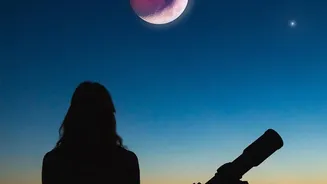
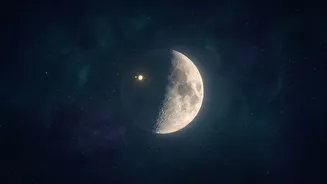
In astronomy, a conjunction occurs when two celestial objects appear close to each other in the sky from our perspective on Earth. Even though the Moon and Saturn look like neighbours during this event, they are, of course, separated by over a billion
kilometres of space. This alignment is a line-of-sight effect, but it provides a fantastic opportunity for stargazers because the Moon acts as a brilliant guidepost, making it incredibly easy to locate planets that might otherwise be harder to identify.
Mark Your Calendar: When to Look
The main conjunction event in October 2026 happens on the evening of October 24. On this night, a nearly full waxing gibbous Moon will appear near Saturn. For viewers in India and surrounding regions, the pair will become visible as dusk fades into darkness and will remain a feature in the sky for much of the night. The days leading up to and following the 24th, from about October 21 to October 25, will also offer good views as the Moon approaches and then moves past the planet.
Finding Your Bearings: Where to Look
You won't need any special directions to begin your search. After sunset on October 24, simply look for the bright, nearly-full Moon. The pair will rise in the east or southeast as darkness falls. As the night progresses, they will climb higher, reaching their highest point in the southern sky around midnight before beginning their descent toward the western horizon in the early morning hours. On the 24th, the Moon will be positioned just to the north of Saturn, making the steady, golden 'star' next to it the planet you're looking for.
How to Tell Saturn From a Star
If you're new to stargazing, you might wonder how to distinguish Saturn from the countless stars surrounding it. There’s a simple trick: planets tend to shine with a steady, constant light, while stars tend to twinkle. This is because stars are so far away that their light comes to us as a single point, which is easily disturbed by Earth’s atmosphere. Planets are much closer, so their light is more stable. Look for a bright, off-white or golden-hued point of light that isn't twinkling—that will be Saturn. Its brightness, at a magnitude of about 0.4, will make it stand out.
Do You Need a Telescope?
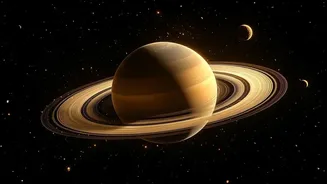
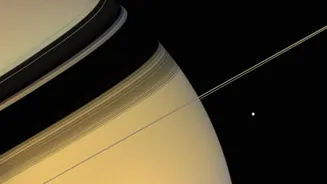
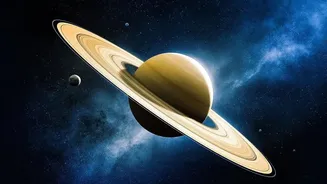
No special equipment is needed to see Saturn itself; it will be clearly visible to the naked eye. However, if you have a pair of binoculars or a small telescope, you're in for a treat. While you won't see the rings without magnification, even a basic telescope can reveal them. The rings are currently tilted at an angle of about 7.5 to 8 degrees toward us, which is enough to make them visible. With a telescope magnifying at least 30 times, you should be able to distinguish the rings from the planet itself, turning a bright dot into a breathtaking celestial object. Binoculars will enhance the view, making Saturn appear slightly oval-shaped.
A Bonus for October Skywatchers
This entire month is an excellent time to observe Saturn. The planet reached opposition on October 4, which is when Earth passed directly between it and the Sun. This alignment means Saturn is at its closest and brightest for the year, making it a prominent feature of the night sky all month long. It rises around sunset and stays visible throughout the night, so even if you miss the conjunction on the 24th, you’ll have plenty of other opportunities to spot the ringed wonder. Just look toward the south after dark for a bright, steady, golden light in the constellation Cetus.