
The Sun's Inevitable Finale
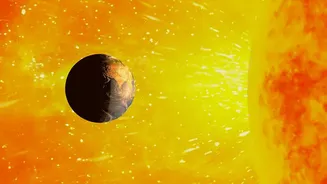
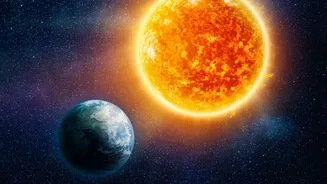
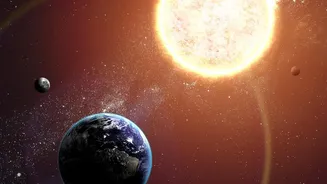
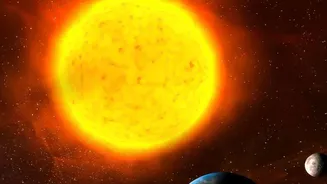
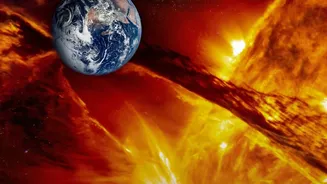
Every star has a life cycle, and our Sun is no exception. Currently a middle-aged star, it will exhaust its hydrogen fuel in roughly five billion years. When this happens, its core will contract while its outer layers expand dramatically, transforming
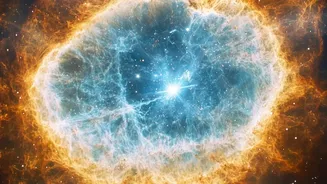
it into a red giant. In this phase, the Sun will swell to engulf the orbits of Mercury, Venus, and almost certainly Earth. After about a billion years as a red giant, the Sun will shed its outer layers, leaving behind an incredibly dense, Earth-sized core known as a white dwarf. This stellar remnant will initially be scorching hot but will gradually cool over trillions of years. This violent transformation marks the beginning of a new, and surprisingly chaotic, era for the surviving planets.
A New Cosmic Dance
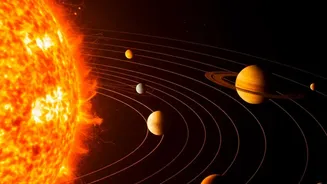
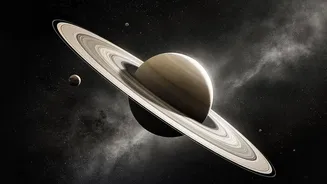
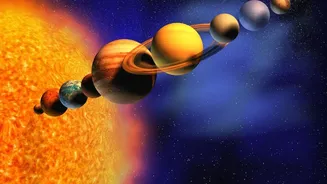
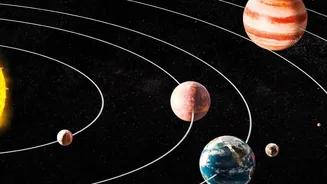
For a long time, astronomers believed that the surviving outer planets—Jupiter, Saturn, Uranus, and Neptune—would simply shift into wider, stable orbits after the Sun becomes a white dwarf. This is because the Sun will have lost nearly half its mass, weakening its gravitational pull. In this scenario, the solar system would continue its stately, silent dance for potentially trillions of years until a passing star disrupted it. However, a recent study from Caltech has thrown a wrench into this tidy picture. New simulations suggest the process of the Sun losing mass won't be a smooth, gentle affair. Instead, it will happen through violent, random ejections of matter, delivering gravitational 'kicks' to the remaining planets.
The Great Destabilisation
These unpredictable kicks will fundamentally alter the gravitational balance of the outer solar system. The new models, which factor in this chaotic mass loss, predict a far more turbulent future for Jupiter and Saturn. According to the simulations, the delicate orbital harmony will be broken. The study, published in The Astrophysical Journal Letters, suggests there is a high probability that the entire outer planetary system will destabilise. This doesn't mean a slow drift, but a period of violent scattering. In about 40% of the simulations, this disruption begins even before the Sun has fully become a white dwarf, during its red giant phase. The once-stable orbits of the gas giants could cross, leading to a cosmic game of billiards.
A Billiard-Ball Ending
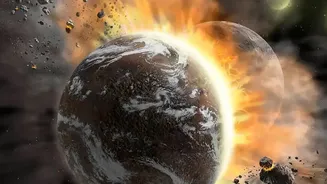
The potential outcomes of this instability are dramatic. The simulations show that planets could be ejected from the solar system entirely, sent wandering into the cold darkness of interstellar space. In other scenarios, planets could swap orbits or be flung into new, highly eccentric paths. The lifespan of our familiar solar system architecture is drastically reduced in this new model. Instead of lasting for near-eternity, the simulations show that in up to 96% of cases, the system becomes unstable within just three billion years after the Sun becomes a white dwarf—a timescale one billion times shorter than previously thought. Far from a quiet retirement, the end of our solar system looks to be a dynamic and disorderly disassembly, orchestrated by the final, sputtering breaths of its parent star. Even the moons of Jupiter and Saturn will undergo immense change, with their icy surfaces potentially melting to form temporary liquid water oceans during the red giant phase.