





What Exactly Is the SunRISE Mission?
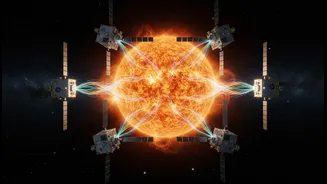
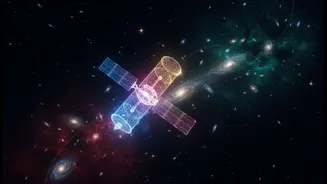
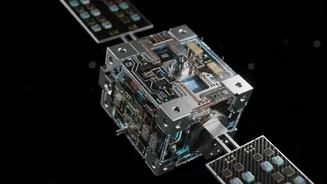
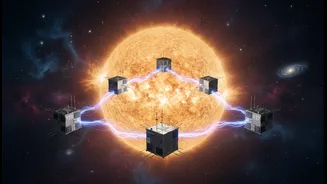
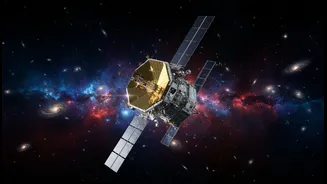
SunRISE, which stands for Sun Radio Interferometer Space Experiment, is not your typical space telescope. Instead of one large observatory, it's a coordinated fleet of six small satellites, each about the size of a toaster oven. These CubeSats will fly
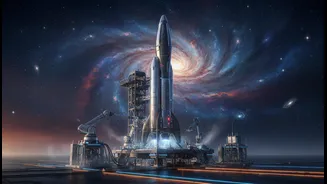
in a loose formation about 22,000 miles above Earth, working together as a single, giant virtual radio telescope spanning 10 kilometres. Their goal is to capture low-frequency radio waves generated by solar particle storms. These radio signals are blocked by Earth's ionosphere, so a space-based observatory is essential. By using a technique called interferometry, the six spacecraft will combine their data to create detailed 3D maps, pinpointing where these powerful particle bursts originate on the Sun and how they travel out into space. The mission is currently scheduled to launch in the summer of 2026. Recently, NASA announced the mission would launch aboard a SpaceX Falcon Heavy rocket, a change from its original plan.
For the Space Enthusiast: A New Window on the Sun
For anyone fascinated by the cosmos, SunRISE offers a thrilling new perspective on our home star. The mission aims to solve fundamental mysteries about the Sun's behaviour, particularly what triggers solar energetic particle (SEP) events. These storms eject massive amounts of radiation that can travel nearly at the speed of light. By listening to the radio crackle that precedes these particles, SunRISE will act as an early warning system. It will help scientists understand the underlying physics of how the Sun accelerates these particles. This research isn't just about our Sun; the insights gained could apply to other stars throughout the universe. SunRISE will essentially create the first-ever 3D movies of how solar eruptions evolve, providing a completely new way to visualize the powerful forces shaping our solar system.
For Satellite Operators: Protecting Critical Assets
For the commercial and government entities operating the thousands of satellites in orbit, space weather is a serious business risk. Solar particle storms can wreak havoc on these expensive assets. The high-energy particles can degrade solar panels, disrupt communications, cause phantom commands in a satellite's electronics, and even lead to total mission failure. A major event can shorten a satellite's operational lifespan, costing millions. This is where SunRISE provides immense value. By tracking the radio emissions that act as a precursor to the arrival of these damaging particles, the mission will provide critical data to improve space weather forecasting. With better and earlier warnings, satellite operators can take protective measures, such as putting spacecraft into a safe mode to minimize damage. This ability to anticipate and mitigate the impact of solar storms is crucial for the long-term sustainability of the growing satellite industry.
For the Student: A Masterclass in Modern Engineering
SunRISE is a powerful educational tool and an inspiration for the next generation of scientists and engineers. The mission is a showcase of cutting-edge technology and clever problem-solving. Building a 10-kilometer-wide telescope in space isn't feasible, so NASA is using a swarm of six small, relatively inexpensive CubeSats to achieve the same result. This demonstrates the power of distributed systems and software-defined radio. Students can learn about orbital mechanics, interferometry, and the challenges of managing a constellation of spacecraft. The mission itself, managed by NASA's Jet Propulsion Laboratory with science led by the University of Michigan, highlights the collaborative nature of modern space exploration. It also serves as a real-world example of how STEM fields directly contribute to protecting our planet's infrastructure and enabling future human exploration of space, including missions to the Moon and Mars.