


Gaganyaan: The Foundational First Step
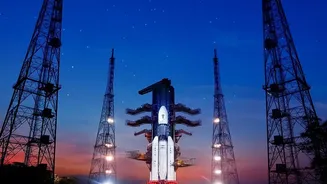
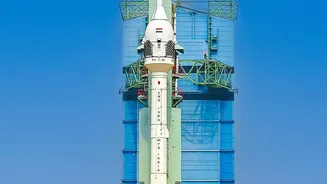
India's journey to becoming a major human spacefaring nation starts with the Gaganyaan mission. This programme is designed to demonstrate the nation's capability to send a crew of astronauts into a 400-kilometer orbit and return them safely to Earth.
Significant progress has already been made, with successful tests of the crew escape system and other critical components. The first uncrewed flight, known as G1, is targeted for late 2026 and will feature a humanoid robot named Vyommitra to validate life support and control systems before any humans fly. This mission is the essential building block, proving the core technologies and procedures needed for any future, more complex human missions. Following a series of uncrewed tests, the first crewed Gaganyaan flight is anticipated around 2027 or 2028, which will officially make India the fourth country to independently send its citizens into orbit.
An Address in Orbit: The Bharatiya Antariksha Station
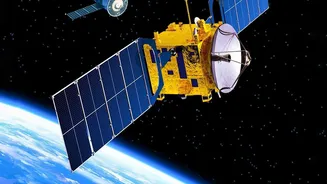
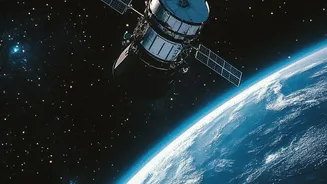
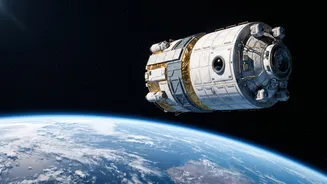
Beyond the short-duration flights of Gaganyaan, the next logical leap is establishing a long-term presence in space. To this end, the Indian Space Research Organisation (ISRO) is planning the Bharatiya Antariksha Station (BAS), a modular space station. The government has approved the project, which aims to have its first module in orbit by 2028. The complete five-module station is planned to be fully operational by 2035, orbiting at an altitude of about 400 km. This station will serve as a crucial platform for scientific research in microgravity and, more importantly, will allow astronauts to gain experience with long-duration space travel. Mastering skills like in-orbit docking, life support for extended periods, and station maintenance are prerequisites for planning interplanetary journeys, including missions to the Moon.
The Lunar Leap: New Rockets and New Skills
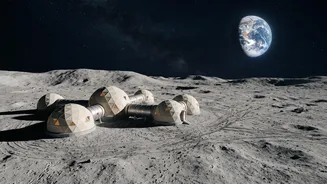
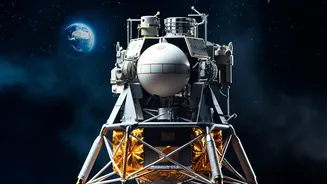
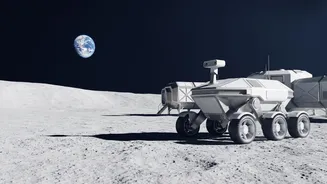
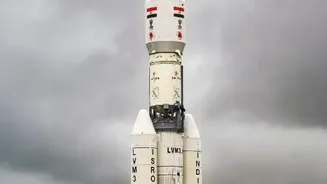
Getting to the Moon requires significantly more power and capability than orbiting the Earth. Recognising this, India has greenlit the development of a Next Generation Launch Vehicle (NGLV). This new family of rockets is designed to be partially reusable, aiming to lower launch costs, and will be capable of carrying much heavier payloads than ISRO's current workhorse, the LVM3. The NGLV is essential for both assembling the space station and launching a crewed lunar mission. The government has set an ambitious target to land an Indian astronaut on the Moon by 2040. This requires not just a powerful rocket but also developing a lunar lander, mastering complex orbital mechanics for a round trip, and ensuring astronauts are trained for the unique challenges of a lunar mission, from landing to surface operations.
Strength in Numbers: Global Collaboration
While India's space program is proudly self-reliant, it is also embracing strategic international partnerships. A key move in this direction was signing the US-led Artemis Accords. This non-binding agreement outlines principles for cooperation in civil space exploration, promoting transparency and interoperability between partner nations. By joining, India ensures it is not isolated technologically and can collaborate with leading space agencies like NASA. This partnership provides access to shared data, best practices from missions like Artemis II, and opportunities for joint missions, potentially accelerating India's own timelines. It aligns India's ambitious national goals with a global framework for the future of space exploration, creating a pathway where collaboration can help overcome the immense technical and financial hurdles of deep-space travel.