




Meet the 'Warm Neptunes'
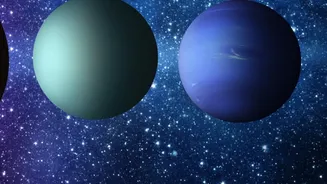
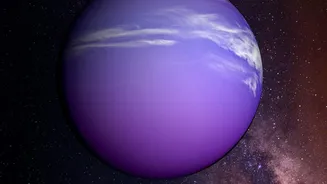
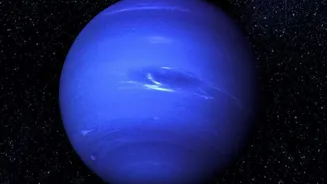
Imagine a planet similar in size to our own Neptune or Uranus, but instead of lurking in the cold, distant reaches of its solar system, it orbits incredibly close to its star. These worlds are known as 'warm Neptunes' or 'hot Neptunes'. They are gas giants,
composed mostly of hydrogen and helium, but their proximity to their star gives them scorching temperatures. These planets represent a class of world entirely absent from our own solar system, and their study offers a unique window into how planetary systems can form and evolve. Because they are so close to their parent stars, some are losing their atmospheres over time, creating comet-like tails of gas. Their existence challenges our understanding and provides a fascinating laboratory for atmospheric science.
Methane: A Promising, Puzzling Chemical
On Earth, the vast majority of methane in our atmosphere is produced by living organisms. This has led scientists to consider it a potential 'biosignature'—a sign of life—if detected on another planet. Methane is an exciting molecule for this purpose because it doesn't last long in an atmosphere like Earth's; starlight breaks it down relatively quickly. Therefore, for it to be present in large quantities, something must be constantly replenishing it. A massive, continuous source could point to a biological process, similar to the methanogens that thrive on our own planet. This is why finding methane on an exoplanet immediately raises intriguing questions.
How Telescopes 'Sniff' the Air
Detecting specific gases hundreds of light-years away sounds like science fiction, but it's a reality thanks to advanced space telescopes like the James Webb Space Telescope (JWST). Scientists use a technique called transit spectroscopy. When an exoplanet passes in front of its star from our point of view (a 'transit'), a tiny fraction of the starlight shines through the planet’s atmosphere. Different gas molecules in the atmosphere absorb specific wavelengths, or colors, of light. By analyzing the starlight that reaches the telescope and seeing which wavelengths are missing, astronomers can deduce the chemical composition of that planet’s air, effectively 'sniffing' its atmosphere from across the galaxy.
The Methane Conundrum
Recently, JWST has successfully detected methane in the atmospheres of several warm gas giants, such as WASP-80 b and WASP-107 b. While a landmark achievement, this is not a discovery of alien life. These warm Neptunes are gaseous worlds, not rocky, Earth-like planets, so life as we know it is not expected. The significance of these findings is twofold. First, it proves that our technology is capable of detecting this potentially crucial biosignature, honing our methods for future searches on more promising, rocky worlds. Second, it helps scientists understand the complex chemistry of these alien atmospheres. For instance, on WASP-107 b, the amount of methane was surprisingly low, suggesting a very hot interior and vigorous atmospheric mixing are at play.
Not All Methane Means Life
The biggest challenge in using methane as a biosignature is the risk of false positives. There are numerous non-biological, or 'abiotic', ways to produce methane. Processes like volcanism and reactions involving water and rock (serpentinization) can also release methane into an atmosphere. For this reason, context is everything. Scientists argue that for methane to be a strong indicator of life, it should be found on a rocky planet in the habitable zone, and ideally in combination with other gases like carbon dioxide, but with very little carbon monoxide. Biological processes tend to consume carbon monoxide, so its absence in a methane-rich atmosphere would be a compelling piece of evidence. The current discoveries on warm Neptunes are helping scientists build the models needed to eventually make these crucial distinctions.