



Meet the Cosmic Nursery
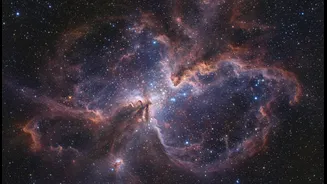
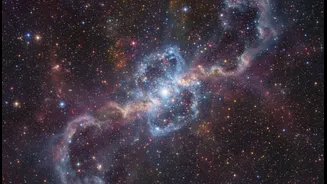
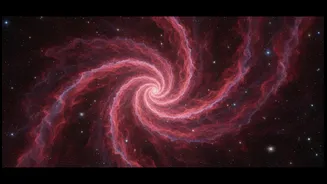
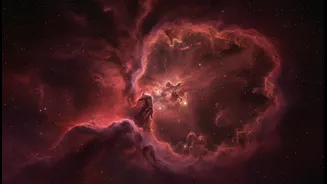
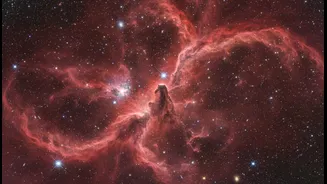
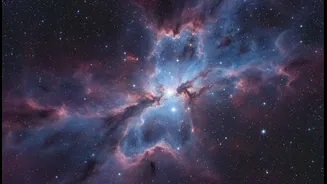
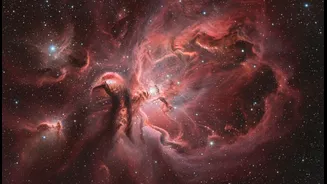
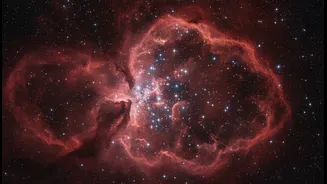
The subject of this spectacular new portrait is a stellar nursery known formally as LH 95. Located in the Large Magellanic Cloud, a small satellite galaxy orbiting our own Milky Way, this region is a bustling hub of cosmic creation. Think of it as a celestial
maternity ward, where thousands of stars are taking shape. The image, released by NASA and the European Space Agency, showcases a brilliant landscape of glowing gas and dust, punctuated by the sparkle of bright blue and white stars. Described by astronomers as a 'stellar association,' LH 95 is home to a mix of young, low-mass stars forming alongside massive blue giants. This environment gives scientists a unique opportunity to study how stars of different sizes are born and evolve in the same neighborhood, all at a relatively close distance in cosmic terms.
The Science Behind the Crimson Glow
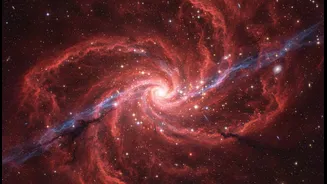
So, why the dramatic crimson color? The stunning red hue isn't just for show; it's a direct result of the intense physics at play within the nebula. The most massive stars in LH 95, some with at least three times the mass of our Sun, are cosmic powerhouses. They blast the surrounding area with powerful stellar winds and intense ultraviolet radiation. This flood of energy heats the vast clouds of hydrogen gas that permeate the region, causing the hydrogen to glow with a characteristic red light known as hydrogen-alpha emission. This specific glow is a tell-tale sign for astronomers, acting as a giant cosmic beacon that signals active star formation is underway. The darker, thread-like filaments seen weaving through the red clouds are denser lanes of cosmic dust that are more resistant to the erosive force of the stellar radiation, creating a beautiful and dramatic contrast.
A Laboratory for Star Birth
Beyond its sheer beauty, LH 95 is a treasure trove of scientific information. The observations revealed around 2,500 'pre-main-sequence' stars. These are essentially baby stars that have gathered most of the gas and dust they need to form but have not yet ignited nuclear fusion in their cores—the process that makes a star truly shine. By studying this massive population of developing stars, researchers confirmed that the rate at which stars gather material from their surrounding environment slows down as they get older, as theories predicted. They also found that this star-building phase can last for several million years, longer than some models had previously suggested. Furthermore, the cloud contains multiple distinct generations of stars existing side-by-side, indicating that star formation in this region is not a single, explosive event but a continuous process that has unfolded over an extended period.
Hubble's Enduring Legacy
This discovery is another feather in the cap for the Hubble Space Telescope, which has been revolutionizing our understanding of the cosmos for over three decades. In an era dominated by the new and powerful James Webb Space Telescope (JWST), which specializes in infrared light, this image is a potent reminder of Hubble's unique and vital capabilities in visible and ultraviolet light. The two telescopes work as partners, with Hubble’s observations often complementing those made by Webb and other observatories. This latest finding from LH 95 shows that even after all these years, Hubble continues to be a critical tool for astronomers, unveiling new secrets of the universe and producing images that capture the public's imagination. It proves that there is always more to discover, and sometimes, the most stunning views are waiting in our own galactic backyard.