







What Was Opposition?
Opposition is an astronomical event that happens once a year for planets farther from the Sun than Earth. On October 4, 2026, Earth passed directly between Saturn and the Sun. From our perspective, this meant Saturn was on the opposite side of the sky
from the Sun, causing it to rise around sunset, dominate the night sky, and set around sunrise. This alignment makes the planet appear at its largest and brightest for the entire year. For India, Saturn rose around 6:11 p.m. on October 4, reached its highest point just after midnight, and was visible all night. While this peak moment has passed, the planet will remain a brilliant fixture in our evening sky for weeks to come.
Your Viewing Guide for the Coming Weeks
The good news is that Saturn's appearance doesn't change dramatically overnight. Throughout October, it will remain a prominent and bright object in the evening sky. To find it, you don't need any special equipment. Just step outside after sunset and look towards the eastern sky. Saturn will appear as a bright, steady, yellowish point of light. Unlike stars, which twinkle, planets shine with a constant glow. The planet is currently located in front of the constellation Cetus, the Whale. As the night goes on, it will travel across the sky, reaching its highest point around midnight before beginning its descent towards the west. Any clear night in October offers a fantastic opportunity for viewing. In fact, on October 24, the moon will appear close to Saturn, creating a beautiful pairing in the east-southeast evening sky.
What Equipment Do You Need?
To simply spot Saturn, all you need are your own eyes. It is bright enough to be easily visible even from light-polluted urban areas, though a darker location is always better. Binoculars will enhance the view, revealing Saturn as a tiny, slightly oval-shaped disc rather than a point of light. You might even spot its largest moon, Titan, as a faint star-like dot nearby. However, to see its most famous feature—the rings—you will need a telescope. But you don't need a professional setup. Even a small amateur telescope with a modest magnification of 25x or 30x is powerful enough to resolve the rings and separate them from the planet's globe. If you have access to a telescope with an aperture of 60mm or more, you'll get an even clearer view.
What to Look For Through a Telescope
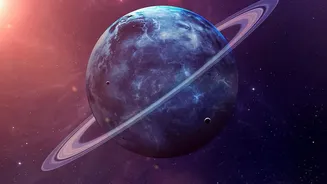
Seeing Saturn's rings for the first time through a telescope is an unforgettable experience. These stunning structures are made of countless particles of ice and rock. With a decent amateur telescope, you may be able to spot the Cassini Division, which is the dark gap separating the main 'A' and 'B' rings. After being nearly edge-on and invisible in 2025, the rings are now tilted towards us again, making them clearly visible. Besides the rings, look for Saturn's brightest and largest moon, Titan. It appears as a small, bright point of light near the planet. With a larger telescope and steady atmospheric conditions, you might also glimpse other moons like Rhea, Dione, and Tethys, or even the pale, subtle cloud bands on the planet itself.