


A New Golden Age of Astronomy
We are living in a revolutionary era for understanding the cosmos. For centuries, planets outside our solar system, or exoplanets, were purely theoretical. Today, we have confirmed thousands, and the game has shifted from simply finding them to understanding what
they are actually like. The headline-making tool behind this shift is the James Webb Space Telescope (JWST). With its massive mirror and unparalleled infrared sensitivity, the JWST is allowing scientists to probe the atmospheres of distant worlds with a level of detail that was previously the stuff of science fiction. It's a global endeavour, with data from this international collaboration rewriting our understanding of how planets form and evolve across the galaxy. This advanced technology is not just finding more planets; it's characterizing them, turning these points of light into tangible places with climates, chemistry, and stories to tell.
The Science of Starlight
So how exactly do you 'read' the air of a planet you can't even visit? The primary technique is called transit spectroscopy. When an exoplanet passes in front of its host star from our point of view, a tiny fraction of the starlight filters through the planet's atmosphere. Different molecules in that atmosphere absorb specific wavelengths, or colours, of light. By analysing the starlight that reaches the telescope, scientists can see which colours are missing and create a 'chemical fingerprint' of the atmosphere. The presence of a strong signal for carbon dioxide, for example, creates a distinct bump in the spectrum that is unmistakable to researchers. This method allows them to identify elements like water vapour, methane, carbon monoxide, and even more exotic compounds, piecing together the atmospheric puzzle from quadrillions of miles away.
Surprising Finds in Alien Skies
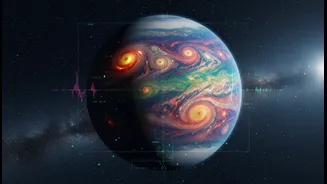
The results from the JWST have already been spectacular and, in many cases, surprising. While the headline mentions gas giants, recent findings have spanned a range of planets. One recent discovery in July 2026 revealed a third planet, Beta Pictoris d, in a well-known system, not by seeing the planet itself but by detecting the chemical signature of its atmosphere. In other cases, the telescope has found atmospheres that defy expectations. On the scorching-hot 'lava planet' 55 Cancri e, scientists expected an atmosphere rich in carbon, but instead found a dynamic, hydrogen-rich atmosphere, possibly sustained by intense volcanic activity. It has even detected atmospheres on rocky, Earth-like planets in the habitable zone, such as LHS 1140 b, a breakthrough that opens the door to assessing their potential for hosting life.
What It All Means
Decoding the atmosphere of a 'hot Jupiter' or a 'super-puff' might seem esoteric, but it has profound implications. The composition of a planet's atmosphere provides vital clues about how and where the planet formed. For example, the ratio of different elements can tell scientists whether a gas giant formed close to its star or migrated inward over time. These findings help refine models of planetary system formation, including our own. More importantly, this technology serves as a crucial dress rehearsal for the ultimate prize: analysing the atmospheres of smaller, rocky, Earth-sized planets. By proving that we can detect key molecules like carbon dioxide, water, and methane on giant planets, scientists are building the toolkit they will need to one day search for biosignatures—the chemical hints of life—on a world much like our own.