



Two Spacecraft, One Ambitious Goal
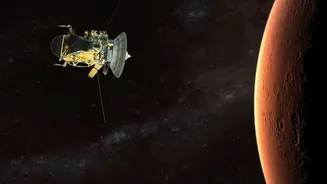
Getting to Mercury is incredibly difficult. A spacecraft must constantly brake against the Sun's immense gravity to avoid overshooting the planet. Launched in 2018, BepiColombo has spent years making nine planetary flybys of Earth, Venus, and Mercury itself
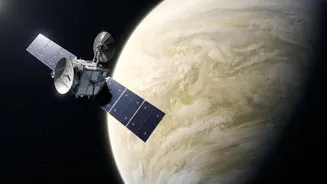
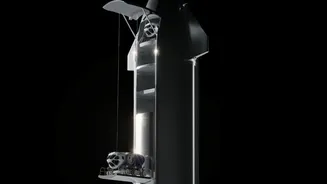
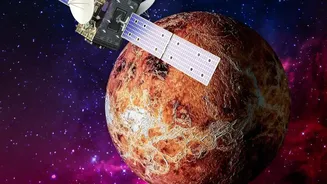
to slow down. Now, its arrival is imminent. The mission actually consists of two separate orbiters that travelled together: the European Space Agency's (ESA) Mercury Planetary Orbiter (MPO) and the Japan Aerospace Exploration Agency's (JAXA) Mercury Magnetospheric Orbiter (Mio). They are scheduled to enter Mercury's orbit in November 2026 and will separate in December to begin their science mission from two different vantage points. MPO will fly close to the planet to map its surface and interior, while Mio will take a wider orbit to study its magnetic field and the surrounding space environment. This dual approach will provide the most comprehensive picture of the planet ever assembled.
The Mystery of the Giant Iron Core
One of Mercury's most perplexing features is its enormous metallic core, which is believed to make up a staggering 85% of the planet's radius. For comparison, Earth's core is much smaller relative to its size. This has led to several theories about Mercury's violent past. One popular idea is that Mercury was once a much larger planet that suffered a colossal impact, stripping away most of its rocky mantle and leaving the dense core behind. Another theory suggests the intense heat of the young Sun vaporised its outer layers. BepiColombo's MPO carries a suite of instruments, including a laser altimeter and a radioscience experiment, that will measure Mercury's gravity field with extreme precision. By tracking the spacecraft's orbit, scientists can map the planet's internal structure and determine if the core is molten, helping to finally solve the riddle of its formation.
A Surprisingly Powerful Magnetosphere
For a small, slow-spinning planet, Mercury has a surprisingly robust magnetic field, about 1% as strong as Earth's. This was a shock when first discovered, as scientists expected a planet of its size to have cooled down and solidified long ago, shutting off the internal dynamo that generates a magnetic field. The existence of this field implies at least part of its iron core is still liquid. JAXA's Mio orbiter is specifically designed to investigate this phenomenon. Its instruments will study the structure and dynamics of Mercury's magnetosphere—the protective magnetic bubble that deflects the harsh solar wind. Understanding why Mercury has a magnetic field while Venus and Mars do not is a key objective that could rewrite our models of how planetary magnetic fields form and evolve.
Searching for Ice in the Scorching Heat
It sounds impossible, but there is water ice on the planet closest to the Sun. Previous missions detected bright radar signatures from the floors of permanently shadowed craters at Mercury's poles. Because the planet's axis has almost no tilt, these regions never see sunlight, and temperatures plummet to incredibly cold levels, allowing ice to remain stable. What remains unknown is where this ice came from and what it's made of. BepiColombo will provide a closer look. The MPO's spectrometers will analyse the composition of the surface, confirming the nature of these deposits and searching for other volatile elements—chemicals that should have boiled off long ago given Mercury's proximity to the Sun. Finding them could provide clues about cometary impacts or the planet's ancient history.