





The Conventional Landing We Know
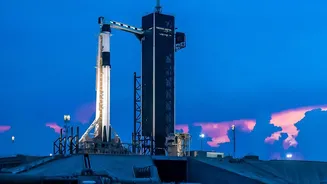
For years, space enthusiasts have marvelled at SpaceX's Falcon 9 boosters returning to Earth. After separating from the second stage, the booster performs a series of engine burns to slow down and steer itself toward a landing zone, either on solid ground
or a floating droneship. It then deploys four landing legs and performs a final 'hoverslam' burn to touch down gently. This method of propulsive landing was revolutionary, turning a piece of hardware that was once discarded in the ocean into a reusable asset. However, it has limitations. The landing legs add significant weight to the rocket, which reduces the amount of payload it can carry to orbit. Furthermore, after landing at sea, the booster must be transported back to port, inspected, and refurbished before it can fly again, a process that takes time.
Introducing the 'Chopsticks'
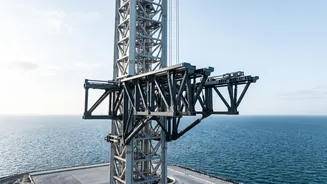
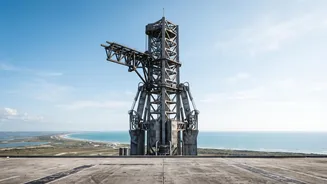
Starship’s Super Heavy booster is a different beast entirely, and it requires a different approach. Standing over 230 feet tall, the booster returns to the launch site just like a Falcon 9, but it has no landing legs. Instead, the 480-foot launch tower itself does the work. Nicknamed 'Mechazilla', the tower is equipped with two giant, movable arms often called the 'chopsticks'. As the returning booster slows to a near-hover using its engines, these arms move to position themselves under a set of strong points near the top of the rocket, just below its grid fins. The arms then close around the booster, securing it in mid-air and lifting it back onto the launch mount. The entire system relies on incredibly precise guidance systems, sensors, and powerful hydraulics to catch a skyscraper-sized object with minimal room for error.
Why Catch Instead of Land?
The decision to catch the Super Heavy booster is driven by two main factors: mass and speed. By removing landing legs, SpaceX strips tons of weight from the booster. Every kilogram saved on the rocket's structure is a kilogram that can be allocated to payload, fuel, or crew, directly increasing the rocket's capability and efficiency. The second, and perhaps more critical, reason is turnaround time. The ultimate goal for Starship is airline-like operations, with multiple launches per day. Catching the booster directly on the launch tower eliminates the need to transport it from a separate landing pad. In theory, a caught booster could be inspected, stacked with a new upper stage, refuelled, and launched again in a matter of hours, a cadence impossible with conventional landing methods.
A High-Risk, High-Reward Gamble
The tower-catch strategy is not without immense risks. While a failed Falcon 9 landing might result in the loss of a booster, a failed catch attempt with Starship could be catastrophic, potentially destroying both the multi-million-dollar booster and the indispensable launch tower. Any significant damage to this 'Stage Zero' infrastructure could set the program back months. The maneuver requires the booster to navigate to a precise point in space while battling atmospheric conditions, with automated systems on the tower making real-time adjustments. The margin for error is incredibly small. A slight deviation in trajectory or a malfunction with the tower's arms could have disastrous consequences, a fact that makes every catch attempt a high-stakes event.
The Vision for a Spacefaring Future
For SpaceX, the 'chopsticks' are more than just an engineering novelty; they are a critical component for achieving its long-term ambitions. Founder Elon Musk's goal of establishing a self-sustaining city on Mars requires launching enormous amounts of cargo and people. This necessitates a launch cadence far beyond anything seen in the history of spaceflight. A Mars-bound Starship, for instance, would need to be refuelled in orbit by multiple 'tanker' Starships, requiring a fleet of boosters to be launched in quick succession during the brief planetary alignment window. This kind of rapid-fire launch schedule is only feasible if the booster can be returned, reset, and relaunched almost immediately. The tower catch is the linchpin of that entire vision.