
Seeing the Past in a New Light
To understand how Webb peers into the cosmic dawn, we first need to grasp a key concept: the universe is expanding. As it expands, the light from the most distant objects gets stretched out on its long journey to us. This phenomenon, known as 'cosmological
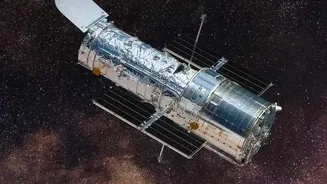
redshift', shifts light from the visible spectrum (what our eyes can see) into the longer wavelengths of infrared light. The farther away an object is, the more its light is redshifted. This means the very first stars and galaxies, which formed a few hundred million years after the Big Bang, are now only visible in the infrared spectrum. Webb was specifically designed to be a master of infrared astronomy, allowing it to see this ancient, stretched light that other telescopes, like Hubble, largely cannot.
Webb’s High-Tech Infrared Eyes
Webb’s ability to capture this faint, ancient light comes from a suite of highly sensitive instruments. Its primary imaging tool, the Near-Infrared Camera (NIRCam), is crucial for detecting the light from the earliest stars and galaxies taking shape. Working alongside it is the Mid-Infrared Instrument (MIRI), which excels at cutting through cosmic dust and observing colder objects. Together, these instruments provide a comprehensive view across the infrared spectrum. To work effectively, these instruments must be kept incredibly cold—around -233 degrees Celsius for MIRI—to prevent the telescope's own heat from interfering with the faint infrared signals from deep space. This technological prowess allows Webb to capture images and data with unprecedented sensitivity and detail.
Peering Through Cosmic Nurseries
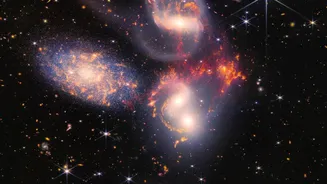
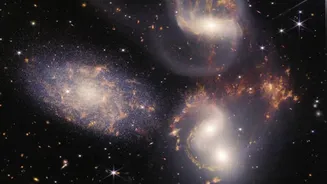
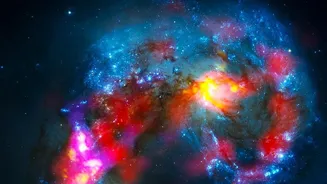
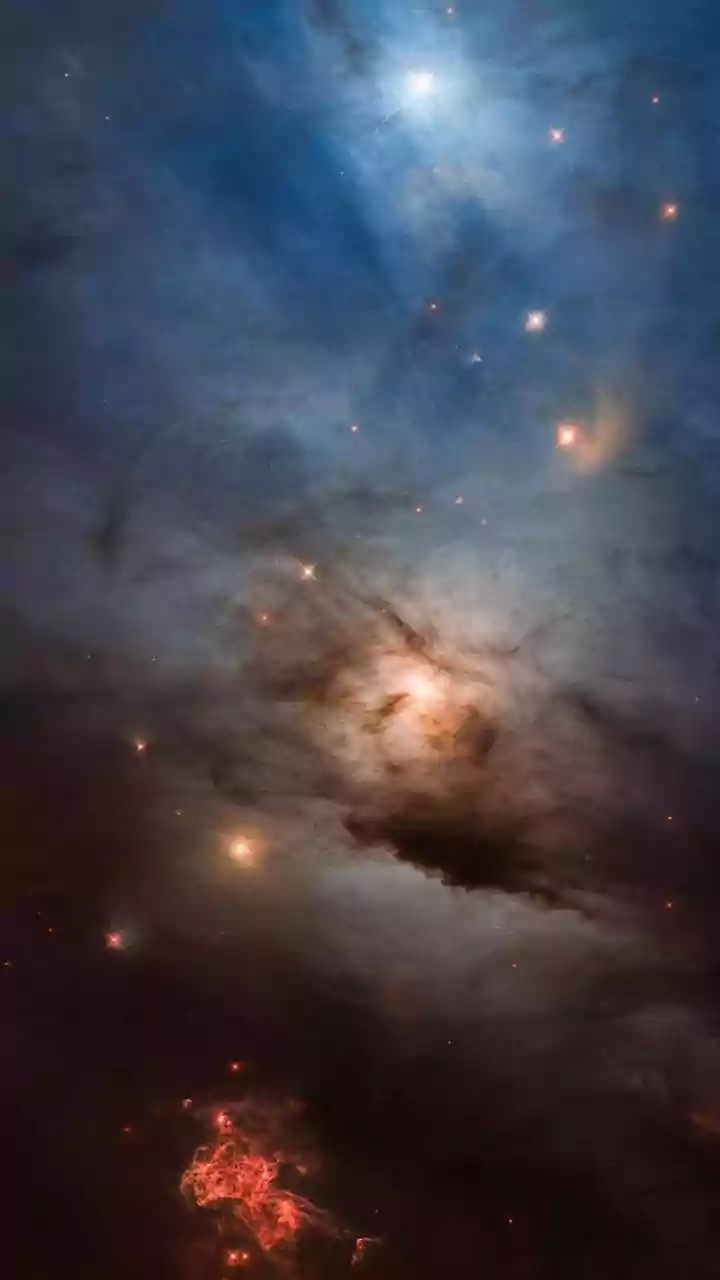
Another major advantage of infrared is its ability to see through the immense clouds of gas and dust that are opaque to visible light. These cosmic clouds are the nurseries where new stars and galaxies are born. Before Webb, our view into these regions was often blocked. Now, Webb’s infrared vision penetrates the dusty veils, revealing the intricate processes of star formation in stunning detail. This allows astronomers to witness how stellar systems come together and how galactic interactions can trigger bursts of star birth, providing invaluable insights into how today's grand galaxies evolved from these early, dusty beginnings.
Rewriting the First Chapter of the Universe
Webb's observations have already started to challenge and refine long-held theories about the early universe. Astronomers were surprised to find galaxies in the cosmic dawn that were far more massive, complex, and mature than models had predicted. Some galaxies, observed just a few hundred million years after the Big Bang, appear to have formed stars at a furious rate and are surprisingly bright. For instance, recent studies have revealed a huge hidden population of faint, low-mass stars in these early galaxies, suggesting they are up to four times more massive than previously thought. These findings are forcing scientists to rethink the timelines for how quickly the first large structures in the universe could form and grow.
Uncovering Mysterious Objects
Beyond just galaxies, Webb is uncovering entirely new cosmic mysteries. It has identified numerous objects dubbed "little red dots," which are now thought to be compact, ancient galaxies hosting rapidly growing supermassive black holes. Recently, astronomers found some of these red dots appearing in pairs, suggesting that galaxy mergers and eventual black hole mergers might have been common in the early universe. These observations could help explain how supermassive black holes, like the one at the centre of our own Milky Way, grew so large so quickly. Webb also played a key role in confirming the earliest known supernova, an exploding star from when the cosmos was just 730 million years old, providing clues about how the early universe was enriched with heavy elements.