






2001: A Space Odyssey (1968)
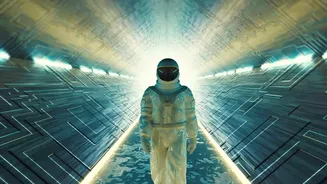
Stanley Kubrick’s magnum opus is less a traditional film and more a cinematic symphony. It tackles the entirety of human evolution, from our prehistoric ancestors discovering the first tool to a journey to Jupiter that confronts the next stage of our development.
The film is famous for its minimal dialogue, instead relying on powerful classical music and breathtaking, scientifically-grounded visuals to tell its story. The special effects, created meticulously in-camera, were revolutionary and still look astounding today. Its central mysteries, embodied by the silent alien monolith and the malfunctioning AI, HAL 9000, pose profound questions about technology, consciousness, and humanity's place in the cosmos that viewers have debated for decades.
Blade Runner (1982)
Though it polarized critics and underperformed at the box office upon release, Ridley Scott's dystopian masterpiece has since become one of the most influential sci-fi films ever made. Set in a rain-soaked, neon-drenched Los Angeles of 2019, the film follows a detective tasked with hunting down bio-engineered androids, known as replicants. More than a simple action story, Blade Runner is a tech-noir that explores complex themes of memory, identity, and what it truly means to be human. Its stunning visual design created the blueprint for the cyberpunk genre, influencing countless films, video games, and anime with its detailed, lived-in future. The film’s ambiguous nature and soulful performances have cemented its legacy as a thought-provoking classic.
Alien (1979)
Ridley Scott masterfully combined the science fiction and horror genres to create a timeless and terrifying experience. The story follows the crew of the commercial space tug Nostromo, who are terrorized by a deadly extraterrestrial lifeform that gets loose on their ship. The film's brilliance lies in its slow-burn tension and its 'haunted house in space' concept. The setting feels gritty and industrial, making the advanced technology seem mundane and the alien threat all the more terrifying. H.R. Giger's biomechanical creature design is the stuff of nightmares, but the film is equally remembered for giving cinema one of its greatest heroes: Sigourney Weaver's Ellen Ripley, a resilient and resourceful protagonist who defied genre conventions.
The Matrix (1999)
Arriving at the turn of the millennium, The Matrix redefined action cinema and brought complex philosophical ideas to mainstream audiences. The film posits that the world we know is a simulated reality created by machines to enslave humanity. Directors The Wachowskis blended concepts from philosophy, religion, and cyberpunk literature with groundbreaking visual effects—most notably the 'bullet time' technique—and martial arts choreography from Hong Kong cinema. The result was a cultural phenomenon that questioned our relationship with technology and reality itself. Its story of awakening to the truth and fighting for freedom has been interpreted in many ways, proving its enduring relevance in an increasingly digital world.
Metropolis (1927)
To understand the visual language of modern science fiction, one must go back to this silent-era German expressionist epic. Though not a Hollywood film, its influence on Hollywood is immeasurable. Director Fritz Lang envisioned a stunning futuristic city of towering skyscrapers and oppressed underground workers. Its groundbreaking special effects and breathtaking art direction created a visual template for urban dystopias that is still being referenced today. The story, a dramatic tale of class struggle and a robot that incites chaos, touches on themes of industrialization and dehumanization. Watching Metropolis is like watching the birth of the sci-fi blockbuster, a visual feast that set the stage for nearly a century of cinematic imagination.