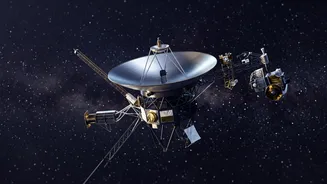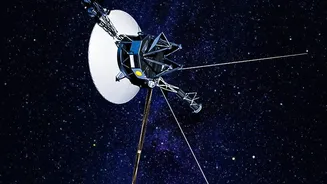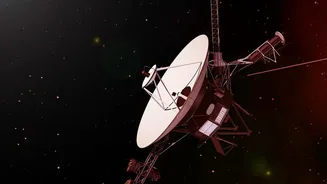

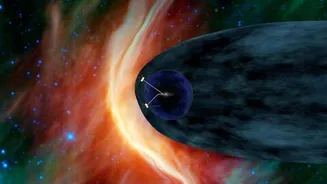
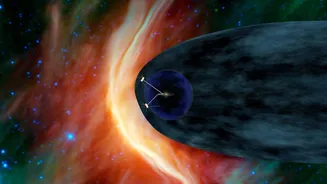

After nearly 50 years traversing the cosmos, NASA's Voyager 1 is about to hit a staggering milestone. On November 18, 2026, it will become the first human-made object to be one light-day away from us. But what does that really mean?
A 'Light-Day' Explained
First, let's break
down the term. A 'light-day' isn't a measure of time, but of distance. It's how far a particle of light travels in a vacuum in 24 hours. Since light is the fastest thing in the universe, that distance is immense: roughly 25.9 billion kilometres. To put that in perspective, light from the Sun takes about 8 minutes to reach Earth. The signal from Voyager 1 on November 18 will take a full 24 hours to get to us. This means any command sent from NASA's Deep Space Network will also take 24 hours to reach the probe, making a round-trip communication a two-day affair.
Voyager's Unprecedented Journey
Launched on September 5, 1977, Voyager 1's original mission was to study Jupiter and Saturn. It revolutionised our understanding of these gas giants, discovering active volcanoes on Jupiter's moon Io and revealing the complexities of Saturn's rings. After its planetary flybys, its mission was extended. In 1990, it turned its camera back to take the iconic 'Pale Blue Dot' photo, showing Earth as a tiny speck from 6.4 billion kilometres away. Then, in August 2012, it made history by crossing into interstellar space, leaving the protective bubble of the Sun's influence known as the heliosphere.
What Happens on November 18?
For the spacecraft itself, nothing will change. Cruising at over 61,000 kilometres per hour, Voyager 1 will simply pass an invisible marker in the vast emptiness of space. The milestone is significant for us back on Earth. It serves as a profound benchmark of human engineering and persistence. The probe has travelled for 49 years to cover a distance that light crosses in a single day. This achievement underscores the almost incomprehensible scale of the universe and highlights the incredible endurance of a machine designed in the 1970s.
A Faint Whisper Across the Void
Keeping a nearly 50 year old probe functioning at such a distance is a monumental challenge. Voyager $^$1$s power, supplied by decaying plutonium, diminishes by about $^$4 watts each year. Engineers have become increasingly creative, shutting down nonessential systems and even recently reviving backup thrusters dormant since $^$1980 to conserve energy and keep its antenna pointed at Earth. The mission has faced recent scares, including a mysterious $^$48 hour communication blackout in October $^$2026, from which the probe recovered on its own. These events highlight the fragility and resilience of this distant explorer.
The Enduring Legacy
While reaching one light day is a major milestone, Voyager $^$1$s journey is far from over. It is currently heading in the direction of a star named Gliese $^$445, though it won''t get close for another $^$40,000 years. NASA scientists hope to keep receiving data from the probe''s remaining active instruments into the $^$2030s. After its power finally fades and its signal goes silent, Voyager $^$1$ will continue its silent trek through the Milky Way for millions of years. It carries with it the Golden Record, a time capsule of sounds and images from Earth, a silent ambassador to the cosmos long after its creators are gone.