





A New Window to Distant Worlds
For much of astronomical history, finding planets outside our solar system was a distant dream. Now, with thousands of exoplanets confirmed, the question has shifted from 'Are they out there?' to 'What are they like?' Specifically, do they have atmospheres,
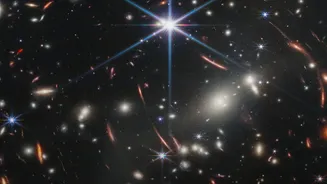
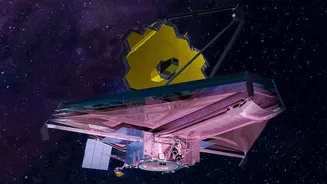
and could those atmospheres support life? This is where infrared atmospheric scans, particularly those conducted by the James Webb Space Telescope (JWST), have opened a new frontier. Unlike visible light, which our eyes can see, infrared is a form of light that we feel as heat. By looking at the universe in infrared, astronomers can detect the chemical fingerprints of gases in a planet’s atmosphere, something often invisible to other telescopes.
Decoding a Planet's Breath
The primary technique used is called transmission spectroscopy. As an exoplanet passes in front of its host star from our perspective, a tiny fraction of the starlight filters through the planet's atmosphere. Different gases in that atmosphere absorb specific wavelengths, or colors, of infrared light. By analyzing the starlight that reaches the telescope, astronomers can see which wavelengths are missing. These missing pieces create a unique barcode, or spectrum, that reveals which molecules are present. This allows scientists to identify gases like carbon dioxide, methane, and water vapor from light-years away, effectively decoding the chemical makeup of a distant world's air.
The Hunt for Biosignatures
The ultimate goal for many is to find 'biosignatures'—gases or combinations of gases that strongly suggest the presence of life. On Earth, life produces a distinct mix of gases, such as oxygen and methane, that would not naturally coexist in large amounts without biological processes constantly replenishing them. The simultaneous detection of methane and carbon dioxide, for instance, could be a compelling biosignature. However, the process is complex. Scientists must rule out all possible non-biological (abiotic) sources for these gases, such as volcanic activity or photochemical reactions, to avoid 'false positives'. The presence of a single gas is not enough; the context of the whole atmosphere is key to building a case for life.
Rocky Planets, Big Challenges
While infrared scans have been transformative, studying small, rocky planets is incredibly difficult. Unlike massive gas giants, Earth-sized worlds have much thinner atmospheres, creating spectral signals that are frustratingly faint. These weak signals can be easily drowned out by the bright light of the host star or instrumental noise. In fact, while the JWST has made groundbreaking measurements, definitively detecting an atmosphere on a rocky, Earth-like planet remains a major challenge. Recent observations of several rocky planets have revealed hot, bare-rock surfaces or suggested no significant atmosphere at all, such as on TRAPPIST-1 b. This shows just how rare and precious a life-sustaining atmosphere might be.
Beyond the Search for Earth 2.0
Even when a rocky planet has an atmosphere, it’s often nothing like our own. Recent JWST observations of the super-Earth 55 Cancri e, a planet likely covered in a magma ocean, suggest it may have a substantial atmosphere rich in carbon monoxide or carbon dioxide. This atmosphere is thought to be 'secondary', bubbling up from the molten interior after the planet’s original atmosphere was blasted away by intense stellar radiation. Another super-Earth, TOI-561 b, also shows strong evidence for an atmosphere over a magma ocean. These findings challenge previous theories, showing some rocky planets can maintain atmospheres even in extreme conditions and providing crucial insights into how planetary atmospheres form and evolve.