



Our Reigning Champion: The Standard Model
For the last few decades, the Lambda-Cold Dark Matter (ΛCDM) model has been the undisputed champion of cosmology. It’s the grand narrative that explains everything from the afterglow of the Big Bang (the Cosmic Microwave Background) to the large-scale
structure of galaxies we see today. The “Lambda” (Λ) represents dark energy, a mysterious force causing the universe to expand at an accelerating rate. The “Cold Dark Matter” refers to a slow-moving, invisible substance that provides the gravitational scaffolding for galaxies to form. This model has been incredibly successful, accurately predicting many of our observations about the cosmos.
A New Eye on the Dawn of Time
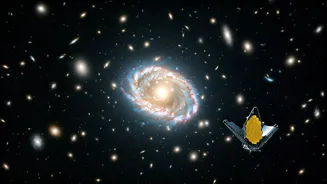
Enter the James Webb Space Telescope (JWST). Launched in 2021, this technological marvel was specifically designed to peer back into the cosmic dawn, capturing infrared light from the universe's first stars and galaxies. Its unprecedented sensitivity and resolution allow it to see objects farther and clearer than ever before, essentially acting as a time machine to witness the universe just a few hundred million years after the Big Bang. Cosmologists were eager to use JWST to confirm predictions made by the Lambda-CDM model about this early era. What they found, however, was a surprise.
The Problem of 'Impossible' Early Galaxies
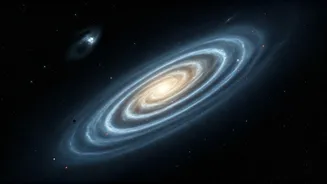
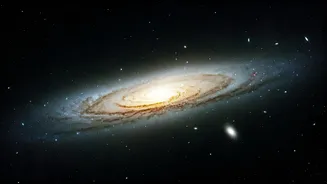
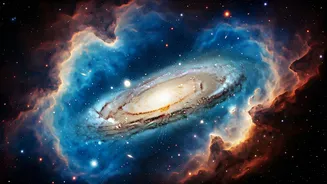
Almost immediately, JWST started spotting galaxies in the early universe that were far too bright, massive, and well-structured. According to the Lambda-CDM model, galaxy formation is a gradual, hierarchical process where small structures merge and grow over billions of years. Yet JWST found galaxies that appeared surprisingly mature only 300 to 500 million years after the Big Bang, a feat that our models suggested should take much longer. These 'impossible' galaxies appeared to have formed too big, too fast, creating a significant tension with our established cosmic timeline.
Deepening the Hubble Tension
Another major puzzle in cosmology is the “Hubble Tension.” This is a persistent disagreement over how fast the universe is expanding right now. Measurements of the early universe (using the Cosmic Microwave Background) predict one speed (about 67 km/s/Mpc), while measurements of the local, modern universe (using stars and supernovae) give a faster speed (about 73 km/s/Mpc). Scientists hoped JWST’s precision might resolve this discrepancy, perhaps by finding errors in the older Hubble Telescope data. Instead, JWST’s more accurate observations have confirmed the local measurements, ruling out previous sources of error and making the tension even harder to ignore.
Crisis or Course Correction?
So, is cosmology broken? Most scientists say no. Instead of a crisis, they see an exciting opportunity. The surprising JWST data is forcing a re-evaluation not necessarily of the entire Big Bang framework, but of the specifics of galaxy formation and the early universe. Theories are emerging to explain the observations, such as star formation being much more efficient or bursting in the early, dense cosmos. Others are exploring whether the seeds of supermassive black holes formed earlier than thought, accelerating galaxy growth. While some research groups suggest the tensions might be resolved with better data, many now believe new physics might be required.