

Beyond the 'Goldilocks' Myth
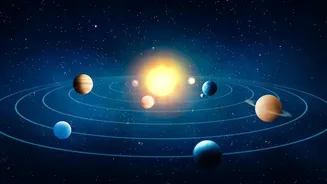
The idea of a habitable zone has been a simple, powerful guide in astronomy: find a rocky planet at the right distance from its star, and you might find liquid water, and maybe even life. This concept places the focus squarely on a planet's orbit. But
as we find more worlds, it is becoming clear that this is an oversimplification. The star itself, the central engine of any solar system, plays a defining role that can make or break a planet's chances of becoming a cradle for life. From a star's size and colour to its age and temperament, these stellar characteristics are now seen as being just as important as the orbital 'zip code' a planet occupies.
A Star's Temperament
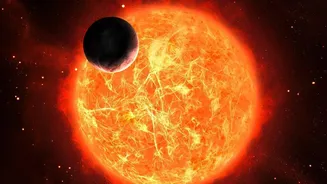
Not all stars are as stable as our Sun. The most common type of stars in our galaxy are M-dwarfs, also known as red dwarfs. These stars are smaller, cooler, and much more numerous than Sun-like stars. Because they are dim, their habitable zones are much closer to the star. This proximity, however, comes with major risks. Young M-dwarfs are notoriously volatile, erupting with powerful stellar flares and coronal mass ejections. These events can blast nearby planets with intense X-ray and ultraviolet (UV) radiation, potentially stripping away their atmospheres over time and sterilizing their surfaces. Research shows that frequent, lower-energy flares can have a greater cumulative impact on atmospheric erosion than less frequent, high-energy ones. A planet in the 'right' orbit around the 'wrong' kind of star might simply be too battered to ever support life.
The Right Kind of Light
Life as we know it depends on a very specific recipe of light for processes like photosynthesis. The type of light a star emits is critical. The chemical composition of a planet's atmosphere is heavily influenced by the ultraviolet radiation from its host star. Too much high-energy UV can be destructive, but some studies suggest it might also be necessary to kickstart the chemical reactions that lead to life. However, the UV spectrum from an M-dwarf is very different from that of our Sun. This can alter atmospheric chemistry in strange ways, sometimes creating 'false positives' for biosignatures, where gases like oxygen and methane are produced without any biological input. Therefore, a planet might receive the perfect amount of heat, but if the light's composition is wrong, life might never get started, or we might misinterpret what we see from afar.
A Matter of Age and Stability
A star's age has a profound impact on its planets. A star needs to be old enough and stable enough for complex life to have a chance to evolve. Life on Earth took billions of years to develop into what it is today. Stars that are too young might still be too active and violent. Conversely, as stars like our Sun get older, they begin to expand. In their later stages, they can grow into red giants, engulfing and destroying their closest planets. Recent surveys have shown a noticeable drop in the number of planets found orbiting very old, evolved stars, suggesting this destructive process is common. This gives habitability a cosmic deadline. Some scientists now suggest that K-dwarf stars—orange dwarfs that are slightly smaller and longer-lived than our Sun but more stable than red dwarfs—might be the true 'sweet spot' for finding long-term, stable homes for life.