
The Sun's Enduring Puzzle
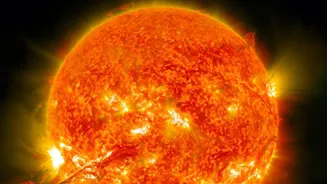
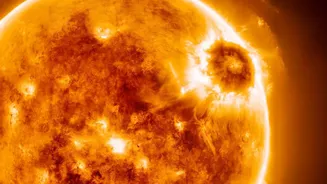
Imagine a campfire that gets hotter the further you move away from it. This is the central paradox of the solar wind. The Sun's surface, the photosphere, is about 5,500°C, but its outer atmosphere, the corona, sizzles at over a million degrees. From this
superheated corona, the Sun constantly spews a stream of charged particles—protons, electrons, and heavy ions—across the solar system. This is the solar wind. For over 60 years, scientists have struggled to explain what gives these particles their incredible push, accelerating them to speeds of up to 1.8 million miles per hour. Standard theories of thermodynamics suggest the wind should cool and slow as it expands, but it doesn't. Solving this acceleration mystery is crucial for understanding not just our Sun, but also for predicting space weather that can impact satellites and power grids on Earth.
Aditya-L1: India's Strategic Vantage Point
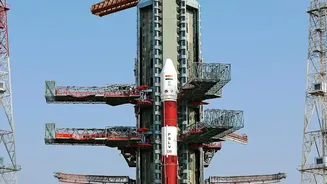
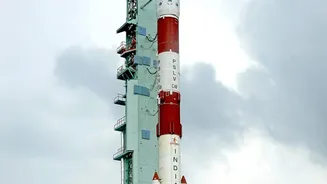
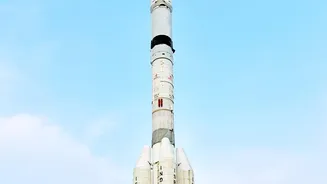
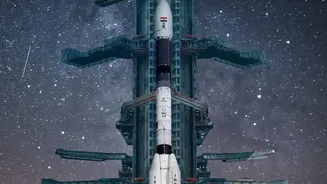
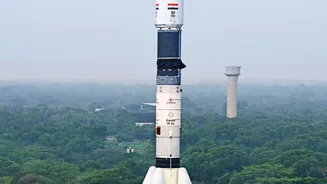
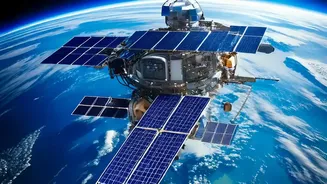
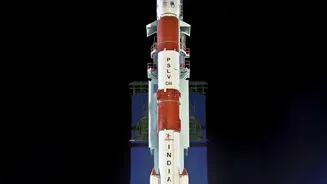
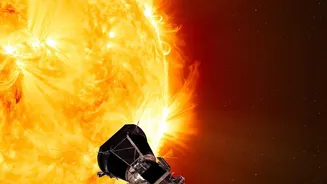
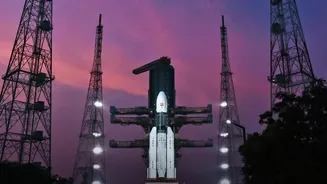
Enter ISRO's Aditya-L1, India's first dedicated solar observatory. Launched in September 2023, the spacecraft is positioned at a unique spot 1.5 million kilometres from Earth, known as Lagrange Point 1 (L1). This location allows it to have a continuous, uninterrupted view of the Sun, free from the interference of Earth's magnetic field. Aditya-L1 is equipped with a suite of seven sophisticated instruments, but three of them are specifically designed to conduct 'in-situ' measurements—sampling the solar wind as it flows past the spacecraft. It's this direct measurement capability that is providing a treasure trove of data for scientists studying the solar wind's strange behaviour.
The Key Players: ASPEX and PAPA
Two of the most critical payloads for this research are the Aditya Solar wind Particle Experiment (ASPEX) and the Plasma Analyser Package for Aditya (PAPA). Together, they act like an advanced weather station for the solar wind. ASPEX contains two components: the Solar Wind Ion Spectrometer (SWIS) and the SupraThermal and Energetic Particle Spectrometer (STEPS). SWIS measures the direction and energy of protons and heavier ions, which make up the bulk of the solar wind. PAPA, meanwhile, focuses on both electrons and ions, studying their energy distribution and composition. Crucially, these instruments don't just count particles; they analyze their speed, direction, and temperature with high precision. This multi-faceted approach is essential for building a complete picture of the wind's properties at any given moment.
A 360-Degree View of the Wind
What makes these sensors revolutionary is not just their individual capabilities, but how they work together. ASPEX, for example, has sensors providing a 360-degree field of view, allowing it to capture a comprehensive measurement of solar wind ions from all directions. This is complemented by the PAPA instrument, which measures both the low-energy electrons and the composition of ions. By combining this data with measurements from the onboard magnetometer (MAG), which studies the interplanetary magnetic field, scientists can connect the dots in a way that wasn't possible before. They can simultaneously see what the wind is made of (composition), where it's going (direction), how hot it is (temperature), and what magnetic forces are acting upon it.
Connecting Theory with Observation
Theories about solar wind acceleration often involve complex phenomena like magnetic reconnection (where magnetic field lines snap and rejoin) and plasma waves that transfer energy to the particles. However, testing these theories requires incredibly detailed data. Aditya-L1's sensors are providing exactly that. For instance, by measuring the ratio of alpha particles to protons, scientists can identify the signatures of Coronal Mass Ejections (CMEs) and understand the processes that drive them. The precise, multi-directional data on particle energy and flow from SWIS and PAPA allows researchers to directly check if the conditions predicted by acceleration theories are actually present in the solar wind. This ability to validate or challenge existing models with high-resolution, real-world data is what truly sets the mission apart and places Indian science at the forefront of heliophysics.