



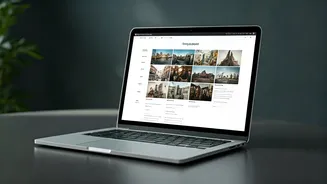




Why Your Static CV Isn't Enough Anymore
For decades, the standard paper resume was the key that unlocked job interviews. It was a simple, text-based summary of your work history and skills. But in a digital-first world, that static document is becoming obsolete. Recruiters today spend mere
seconds scanning each CV, looking for compelling reasons to pay closer attention. [23] A flat list of responsibilities doesn't capture your problem-solving skills, creativity, or the real-world impact of your work. The modern job market demands proof, not just promises. An interactive CV, enhanced with links to a digital portfolio, provides that proof instantly. It transforms your resume from a passive document into an active showcase, inviting hiring managers to explore your projects, designs, code, or writing samples with a single click. [17] This demonstrates not only your skills but also your initiative and digital fluency—qualities highly valued in any industry.
Choosing the Right Platform for Your Portfolio
Before you can add links, you need a place to host your work. This is your digital portfolio—a central hub for your best projects. The platform you choose depends on your profession. For visual professionals like graphic designers and illustrators, Behance and Dribbble are industry standards, offering a community and exposure. [15, 21] Writers and journalists might prefer a clean, article-focused site like Journo Portfolio. [7] For developers and data scientists, a well-organized GitHub profile is non-negotiable. For those who want more control over layout and storytelling without writing code, platforms like Canva, Wix, and Notion offer free, user-friendly templates to build a professional-looking portfolio website quickly. [2, 4] The goal isn't to use the most complex tool, but the one that best presents your work in a clean, professional, and easy-to-navigate format. [2, 15]
Curating Your Best Work: Quality Over Quantity
Your portfolio should be a highlight reel, not a comprehensive archive of everything you've ever done. [5] Select 3-5 of your strongest projects that showcase the range of your abilities and align with the types of roles you're targeting. For each project, don't just show the final product. Tell a story. [2] Write a brief case study that explains the problem you were trying to solve, the process you followed, your specific role and contribution, and the results or impact of your work. [1] This context is crucial; it demonstrates your strategic thinking and problem-solving skills, which are far more valuable to an employer than just a pretty picture or a line of code. High-quality visuals, clear descriptions, and measurable outcomes will make your portfolio memorable and effective. [1]
How to Add Clickable Links to Your PDF CV
Once your online portfolio is ready, it's time to integrate it into your CV. The process is simple and can be done in most word processing programs like Microsoft Word or Google Docs before exporting to PDF. First, identify where the links should go. The most important link—to your main portfolio page—should be in your contact information section at the top. [21] Then, within your 'Experience' or a dedicated 'Projects' section, you can link specific project titles directly to their case studies. [21] To create a link, highlight the text you want to make clickable (e.g., "View Project Portfolio" or the project's name), right-click, and select 'Link' or 'Hyperlink'. [17, 19] Paste the full URL (starting with https://) into the address field. Always save and share your final CV as a PDF, as this preserves the active hyperlinks, ensuring they work for any recruiter on any device. [18, 19]
Best Practices for an Interactive CV
To make your interactive CV effective, follow a few key rules. First, keep it clean. Don't overload the document with dozens of links; be selective and strategic. [9] Use clear and descriptive text for your links, such as "View my UX design portfolio" instead of just pasting a raw URL. [17] Before sending your application, test every single link to make sure it works perfectly. A broken link is worse than no link at all. [21] It's also wise to keep a standard, non-interactive version of your resume handy, as some older application systems or conservative hiring managers may prefer it. [20] Finally, ensure your LinkedIn profile is up-to-date and linked in your header as well; it's another key part of your professional online presence. [17] Your interactive CV should feel like a professional, cohesive package that makes the recruiter's job easier.