




The Sun's Hidden Engine Room
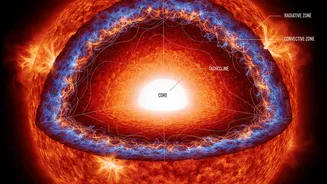
Deep below the Sun's visible surface lies a region of immense scientific interest: the tachocline. It is a surprisingly thin boundary, estimated to be less than 5% of the Sun's radius, separating two distinct inner zones. Below it, the Sun's radiative
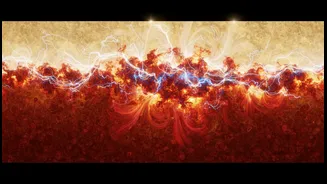
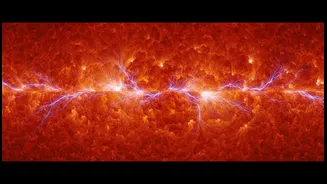
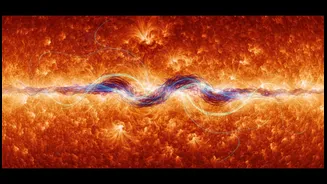
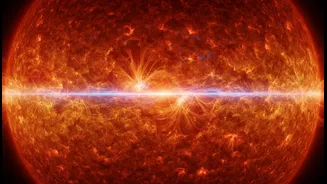
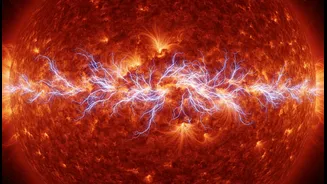
core rotates like a solid, unified ball. Above it, the convection zone churns like boiling water, with different parts rotating at different speeds—faster at the equator and slower at the poles. The tachocline is the shear layer where these two dramatically different motions meet. This sharp transition in rotation is crucial because scientists believe it is the primary location where the Sun's powerful magnetic field is generated.
The Magnetic Heartbeat of the Sun
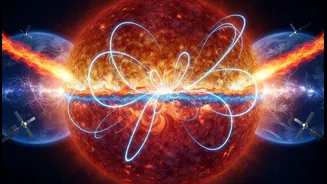
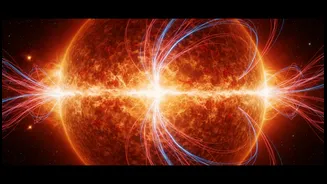
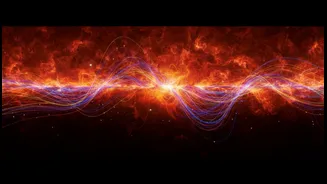
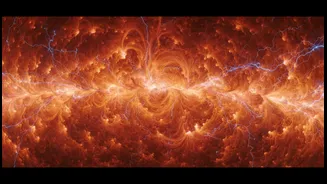
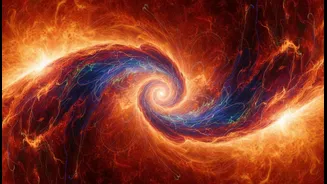
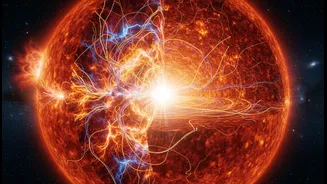
This process of generating a magnetic field is known as the solar dynamo. The immense shearing forces within the tachocline twist and amplify the Sun's magnetic field lines, much like twisting a rubber band stores energy. This stored magnetic energy is what drives the Sun's roughly 11-year solar cycle. This cycle marks a fluctuation in solar activity, from a quiet period (solar minimum) to a stormy one (solar maximum), before the Sun's magnetic poles completely flip and the cycle begins anew. The tachocline is therefore not just a structural layer; it is the fundamental powerhouse that dictates the Sun's magnetic heartbeat and its periodic outbursts.
From Solar Storms to Earth's Doorstep
When the magnetic fields generated in the tachocline become overly stressed, they can burst through the Sun's surface, creating sunspots. These sunspots are often the sites of violent solar events. Solar flares are intense bursts of radiation that travel at the speed of light, while Coronal Mass Ejections (CMEs) are colossal explosions of plasma and magnetic fields flung out into space. A CME can hurl billions of tons of material at speeds up to 3,000 kilometres per second, capable of reaching Earth in as little as 15-18 hours. These phenomena are the primary components of what we call "space weather," and the tachocline is where their journey begins.
Why Space Weather Matters in India
While the aurora borealis is a beautiful side effect, severe space weather poses significant risks to our modern infrastructure. For a nation like India, which is rapidly expanding its technological and space-based assets, the impacts are very real. Geomagnetic storms, caused by CMEs interacting with Earth's magnetic field, can induce powerful currents in power grids, potentially causing widespread blackouts and damaging transformers. These storms also disrupt satellite operations, which are critical for everything from GPS navigation and telecommunications to weather forecasting and financial transactions. Signal disruptions can affect aviation, online banking, and even ride-hailing apps. As India continues to advance its space programs and reliance on satellite technology, understanding the source of these solar storms is crucial for national security and economic stability.