



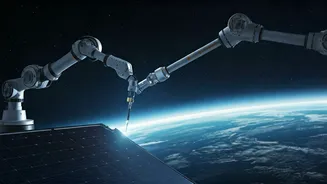


What is Satellite Servicing?
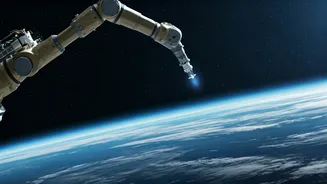
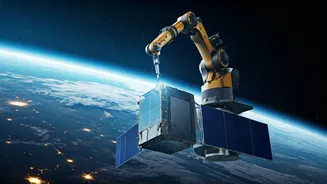
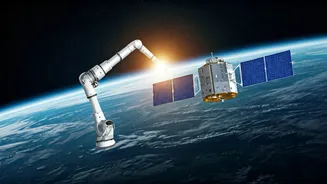
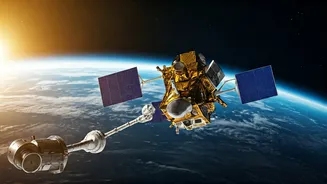
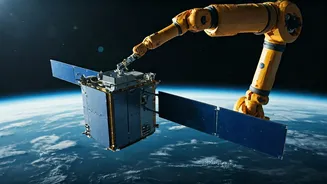
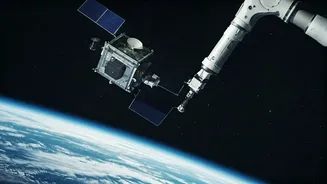
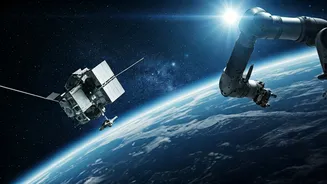
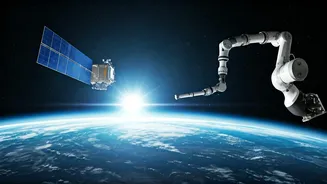
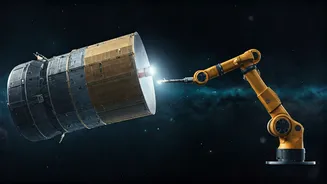
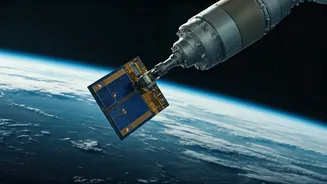
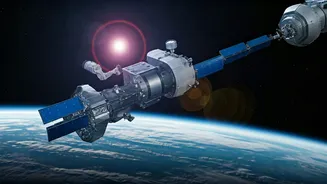
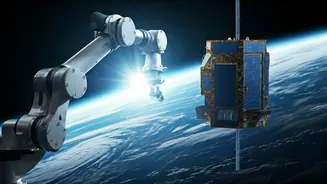
In-orbit servicing is like roadside assistance for spacecraft. It involves sending a robotic 'servicer' satellite to meet a 'client' satellite to perform a variety of tasks that were previously impossible. These services include refueling, repairing or replacing
worn-out components, upgrading technology, and repositioning a satellite to a more optimal orbit. The most common service so far is life extension, where a servicer docks with a satellite that is low on fuel and takes over propulsion duties, effectively giving the expensive hardware a new lease on life. The goal is to transform single-use, multi-million-dollar assets into maintainable ones.
From Theory to Reality
While astronauts have manually repaired satellites before, most famously the Hubble Space Telescope, the concept of a purely commercial, robotic service is new. The turning point came with missions like Northrop Grumman's Mission Extension Vehicle (MEV). In 2020, MEV-1 made history by successfully docking with an Intelsat communications satellite that had run out of fuel but was otherwise perfectly functional. The MEV-1 took over propulsion and extended the satellite's revenue-generating life by five years before undocking in 2025 to find its next client. A second vehicle, MEV-2, performed a similar mission. These successful missions proved that a commercial business case existed, shifting satellite servicing from a theoretical possibility to a proven, bankable service.
The Business of Staying in Orbit
The economic driver behind satellite servicing is powerful. A modern geostationary communications satellite can cost between $350 million and $500 million to build and launch. Often, the only thing that forces these assets into retirement is a lack of fuel. A servicing mission that extends a satellite's life by five or more years, for a fraction of the replacement cost, offers a clear return on investment. This has created a burgeoning market, projected to grow from $4.8 billion in 2025 to over $17 billion by 2034. Companies like Northrop Grumman's subsidiary SpaceLogistics, Maxar Technologies, and Orbit Fab are now key players, offering services that were unimaginable just a decade ago.
A Cleaner, More Sustainable Orbit
Beyond the economics, satellite servicing is critical for long-term orbital sustainability. Thousands of active satellites orbit Earth, with tens of thousands more projected to launch. This has created a growing crisis of space debris, where defunct satellites and spent rocket stages pose a collision risk to active ones. Companies like Japan's Astroscale are pioneering Active Debris Removal (ADR) services. Astroscale's ADRAS-J mission recently completed a successful inspection of a large piece of space debris, a critical first step toward being able to capture and de-orbit it. Its earlier ELSA-d mission demonstrated the technologies needed to dock with and remove debris. These capabilities are essential for keeping valuable orbits safe and usable for future generations.
What Comes Next?
The practical era of satellite servicing is just the beginning. The same technologies that allow for refueling and repair are the foundation for a much broader in-space economy. The next frontier is In-space Servicing, Assembly, and Manufacturing (ISAM). This involves not just servicing satellites, but building entirely new, larger, and more complex structures in orbit that would be too big to launch from Earth. Imagine space telescopes with massive mirrors assembled by robots, or even in-space manufacturing facilities. Governments, including the U.S., are now developing national strategies to foster these capabilities, recognizing them as critical for future scientific, commercial, and national security interests. The ability to work on things in space, rather than just launching them, fundamentally changes what is possible.