



From Dots of Light to Data Streams
For a long time, the hunt for exoplanets—planets orbiting stars other than our Sun—was a numbers game. Telescopes like NASA's Kepler were designed to find these distant worlds by watching for the faint dimming of a star as a planet passed in front of it.
This method, known as transit photometry, was incredibly successful, revealing thousands of planets and confirming that our galaxy is teeming with them. But finding these dots of light was only the beginning. The new frontier is characterization: figuring out what these worlds are actually like. This marks a pivotal shift from discovery to diagnostics. The science has matured from simply cataloging planets to analyzing them in detail, and the key to this is decoding the chemical secrets hidden in their atmospheres.
The Ultimate Toolkit for Alien Air
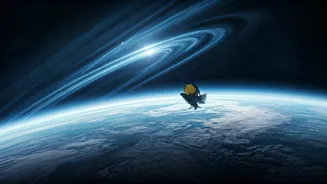
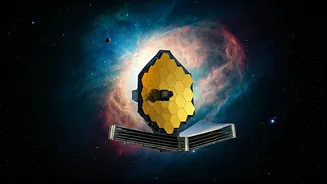
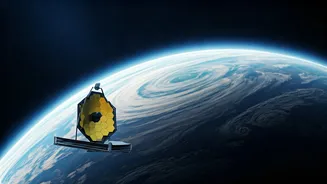
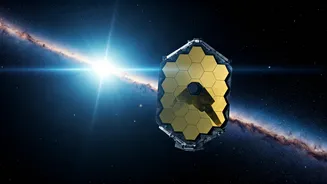
The engine driving this new era is the James Webb Space Telescope (JWST). As a successor to the Hubble Space Telescope, JWST is specifically designed to see the universe in infrared light. This capability is crucial for studying exoplanet atmospheres. When a planet transits its star, a tiny fraction of the starlight filters through the planet's atmospheric fringe. Different gases in that atmosphere absorb specific wavelengths, or colors, of light. By capturing a spectrum—a breakdown of this light—JWST can identify the chemical fingerprints of molecules like water vapor, methane, and carbon dioxide. This technique, called transmission spectroscopy, effectively allows scientists to perform a chemical analysis of a world light-years away. The telescope's unprecedented sensitivity is turning what were once theoretical possibilities into a steady flow of observational data.
What's in the Air Out There?
The data feed from JWST has already delivered a gallery of atmospheric portraits. On the hot gas giant WASP-96b, the telescope found unambiguous evidence of water vapor. For another planet, WASP-39 b, it provided a complete profile of atmospheric carbon dioxide, demonstrating its ability to detect this key gas even in the atmospheres of smaller, rockier worlds. The famous TRAPPIST-1 system, with its seven Earth-sized planets, is a prime target. While the innermost planets appear to be bare rock, likely stripped of their atmospheres by their volatile star, observations of the planets in the habitable zone, like TRAPPIST-1 e, are ongoing and complex. Current data has ruled out a thick, Venus-like carbon dioxide atmosphere but hasn't yet confirmed or denied a thinner, Earth-like one.
The Tentative Search for Life
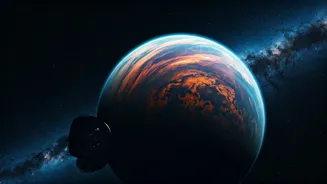
The most tantalizing discoveries involve potential biosignatures—gases that, on Earth, are produced by living organisms. Observations of K2-18 b, a 'super-Earth' located 124 light-years away, have detected methane and carbon dioxide. More intriguingly, some studies suggest the possible presence of dimethyl sulfide (DMS), a substance that, on our planet, is overwhelmingly produced by marine life. Scientists remain extremely cautious, emphasizing that this is not a confirmation of life. The signal is faint, and unknown geological or chemical processes on an alien world could potentially produce DMS without biology. Still, the detection of such molecules marks a profound step forward, moving the search for life from a theoretical exercise to an observational science. It highlights that we now have the tools to find these clues if they exist.
A New Scientific Economy
The headline is not just a metaphor; a genuine 'feed' of data is now flowing to the scientific community. The JWST doesn't just produce single discoveries; it generates vast datasets from each observation, which will be analyzed and re-analyzed by teams around the world for years to come. This creates a new economy of scientific inquiry, where the 'raw material' is starlight filtered through alien skies. This sustained flow of information allows for comparative planetology on a grand scale, letting scientists contrast the atmospheres of sibling planets in the same system or similar-sized planets around different types of stars. We are no longer just taking snapshots; we are building a dynamic, evolving picture of the galaxy's atmospheric chemistry.