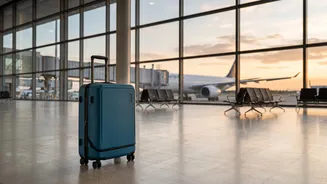







The 'One Bag' Rule Is Now Strictly Enforced
The most significant change affecting flyers departing from India is the strict enforcement of a 'one-piece' cabin baggage policy. While the rule has been on the books for years, India's Bureau of Civil Aviation Security (BCAS) and the CISF are now rigorously
applying it at security checkpoints across all airports for both domestic and international flights. Previously, many travellers could pass through security with a roller bag, a separate laptop bag, and a handbag. That is no longer the case. The primary reason for this crackdown is to reduce congestion in security queues and speed up boarding times as Indian aviation continues to boom. For most economy class passengers, this single bag is limited to 7 kg.
The Personal Item Puzzle: Official Rule vs. Airport Reality
Here's where it gets complicated. Officially, the BCAS rule allows for one primary cabin bag plus one small personal item, such as a handbag, camera, or laptop sleeve. However, the on-ground reality at the boarding gate can be different. To ensure flights depart on time, airline staff frequently ask passengers to consolidate all their belongings into the single main cabin bag. A separate handbag or laptop backpack is often the cause of last-minute repacking at the gate. The wisest strategy for travellers in 2026 is to pack with the expectation that everything must fit into one bag. Choose a cabin bag that can accommodate your purse or laptop, ensuring you can comply if asked to consolidate. Think of the personal item as a bonus, not a guarantee.
Power Banks and Electronics: New In-Flight Safety Rules
The rules for carrying power banks have also become more specific. As always, they are strictly forbidden in checked-in luggage and must be carried in your cabin bag due to fire safety regulations. The key update for travellers is the guidance on their use in-flight. Many Indian carriers now explicitly instruct passengers not to use power banks to charge devices while on the aircraft. You may also be asked to keep them in the seat pocket in front of you rather than in the overhead bin, allowing cabin crew to monitor them. For capacity, power banks up to 100Wh are generally permitted without issue, while those between 100Wh and 160Wh require airline approval.
Check-In Luggage: It Always Pays to Check Your Airline
While the one-bag cabin rule is a universal mandate from BCAS, checked baggage allowances remain at the discretion of individual airlines. This is where passengers must be most vigilant. Low-cost carriers like IndiGo, SpiceJet, and Akasa Air typically offer a 15 kg checked baggage allowance on their standard domestic fares. Full-service carriers like Air India may offer more generous allowances, sometimes up to 25 kg on domestic routes. For international flights, the allowance is usually based on the route and can be either a weight limit or a piece concept (e.g., two bags of 23 kg each). The golden rule is to always check the specific allowance tied to your ticket and pre-purchase any extra weight online, as it is significantly more expensive at the airport counter.
Good News for Arrivals: Increased Customs Allowances
It’s not all restrictions. For those arriving in India, the new Customs Baggage Rules, which took effect in early 2026, bring some welcome benefits. The duty-free allowance for Indian residents returning after staying abroad has been increased from ₹50,000 to ₹75,000. Furthermore, the rules have introduced clearer, weight-based allowances for gold jewellery for those who have resided abroad for over a year: women can bring up to 40 grams duty-free, and men up to 20 grams. Additionally, any passenger over the age of 18 is now permitted to bring one new laptop into the country duty-free, over and above their standard allowance.