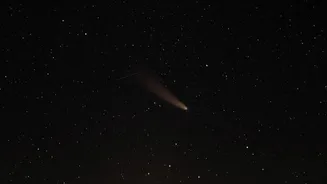



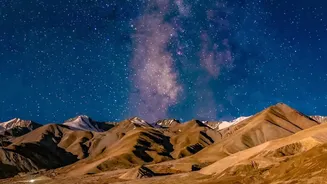

As city skies grow brighter, a new travel trend is taking hold: the search for darkness. In response, remote eco-resorts across India are transforming into celestial sanctuaries for a growing number of avid stargazing travelers.
From Amenity to Identity
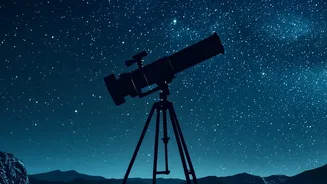
Not long ago, a hotel telescope
was a quirky, often-forgotten amenity. Today, it’s the centerpiece of a burgeoning travel movement. With over 80% of the world's population living under light-polluted skies, the experience of seeing a truly dark, star-filled night has become a luxury. Indian eco-resorts, particularly in pristine locations like Ladakh, Rajasthan, and the Himalayas, are recognizing that their greatest asset isn't just the landscape, but the sky above it. This has led to a fundamental shift: instead of just offering a place to sleep, they are creating immersive astronomical experiences. Resorts like Astroport Sariska in Rajasthan, India's first dedicated astro-resort, were built entirely around this concept, blending hospitality with a deep-sky observatory.
Designing for Darkness
The most significant adaptation is a conscious effort to combat light pollution on-site. New and renovated resorts in prime stargazing zones are implementing 'dark sky friendly' lighting plans. This involves using shielded, downward-facing fixtures that illuminate pathways without casting a glow upward. Many use low-intensity, warm-hued LED lights that are less disruptive to both wildlife and human night vision. Some establishments are creating designated 'dark zones' within their properties, areas completely free of artificial light where guests can gather for observation. This architectural discipline extends to being fully solar-powered and operating as zero-plastic zones, as seen at Astroport Sariska, ensuring the entire experience is low-impact.
On-Site Expertise and Equipment
Simply providing darkness isn't enough. Leading resorts now employ resident astronomers or partner with local experts to guide guests through the cosmos. These experts lead nightly sessions, helping travelers identify constellations, spot planets like Saturn and Jupiter, and understand celestial events. They transform a passive viewing into an educational and engaging event. Highnd equipment, from largenderture Dobsonian telescopes to specialized cameras for astrophotography, is becoming standard. At luxury camps like SUJÁN The Serai near Jaisalmer, expert naturalists pull double duty, interpreting both the desert landscape by day and the constellations by night. This human element is crucial, making complex astronomy accessible and inspiring for all ages.
Rooms with a Cosmic View
The experience is also being integrated directly into the accommodations. At The Kyagar in Ladakh’s Nubra Valley, rooms feature retractable skylights, allowing guests to stargaze from the comfort of their beds. Similarly, the Tree of Life Eila Art Hotel in Himachal Pradesh offers a 'Skyscape' room with a large ceiling skylight for private cosmic viewing. Beyond architectural features, rooms are often equipped with star charts, binoculars, and literature about the night sky. These touches reinforce the stargazing theme and empower guests to explore the sky on their own time, creating a more personal and profound connection with the universe above.
A Community-Centric Approach
This trend is also fostering sustainable development in remote regions. In places like Hanle, Ladakh—designated as India's first Dark Sky Reserve—the local community is deeply involved. Villagers are trained as 'astronomy ambassadors', running homestays and guiding tours, which creates new sources of income. This model ensures that the economic benefits of tourism are shared, and it empowers local communities to become guardians of their pristine night skies. Initiatives are underway to develop entire 'Astro-villages' in states like Uttarakhand, further embedding this unique form of eco tourism into the rural economy.