


A Venus Twin That Isn't
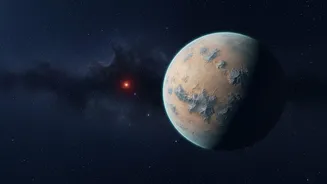
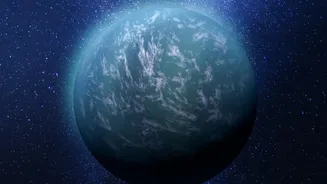
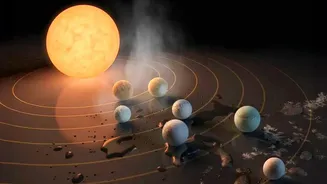
Just 40 light-years from Earth lies one of the most intriguing planetary systems ever discovered: TRAPPIST-1. It hosts seven rocky, Earth-sized planets orbiting a cool, red dwarf star. Scientists have been particularly interested in TRAPPIST-1 c, a world
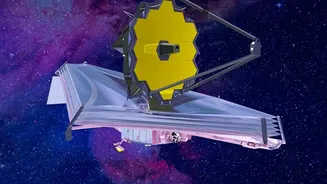
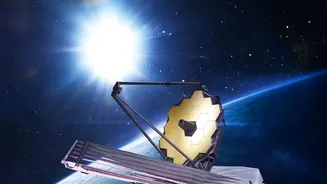
roughly the same size as Venus that receives a similar amount of radiation from its star. This led to a compelling hypothesis: could TRAPPIST-1 c be a Venus twin, shrouded in a thick, crushingly dense atmosphere of carbon dioxide? Thanks to the incredible precision of the James Webb Space Telescope (JWST), we now have an answer. By measuring the heat radiating from the planet’s day side, astronomers have definitively ruled out a Venus-like scenario. The data shows that a thick CO2 atmosphere is not present, challenging our assumptions about how planets in other solar systems form and evolve.
Reading the Heat Signature
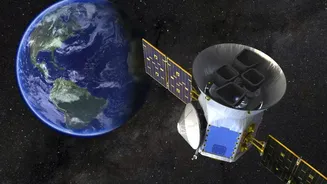
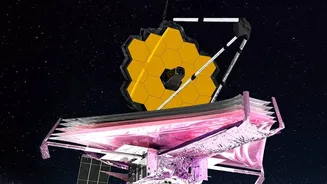
So how exactly does a telescope millions of kilometres away take a planet's temperature? The technique involves measuring the planet's thermal emission, or the infrared light it gives off. Using its Mid-Infrared Instrument (MIRI), JWST stared at the TRAPPIST-1 system and measured the combined light of the star and planet. It then waited for the planet to pass behind its star, a moment called a secondary eclipse, and measured the light from just the star. By subtracting the second measurement from the first, astronomers could isolate the heat energy coming directly from TRAPPIST-1 c's dayside. The resulting temperature was about 107 degrees Celsius (225 F). While hot, this is significantly cooler than the 475 degrees Celsius on Venus, whose thick CO2 blanket creates a runaway greenhouse effect. The observed temperature on TRAPPIST-1 c is too high for a planet with no atmosphere, but far too low for one with a thick one, effectively ruling out the Venus comparison.
An Extremely Thin Veil, or Bare Rock
The findings leave two main possibilities. TRAPPIST-1 c could either be a barren rock with no atmosphere at all, or it might possess an extremely tenuous atmosphere. The data is consistent with a very thin carbon dioxide atmosphere, one far thinner than Earth's or even Mars'. This result is a triumph for the JWST, as it marks the first time scientists have been able to search for atmospheres dominated by heavier molecules like oxygen, nitrogen, and carbon dioxide on a rocky world this cool. Previously, studies were limited to planets with thick, hydrogen-rich atmospheres. The ability to detect such subtle atmospheric signals, or their absence, on small, rocky worlds represents a major technological leap and a key return on the investment in the Webb telescope. This capability is crucial for the ultimate goal of finding worlds that might support life.
Implications for the Search for Life
While a world that is either bare rock or has a wisp of a CO2 atmosphere isn't a candidate for life, the finding is far from a disappointment. It provides a critical piece of the puzzle. Red dwarf stars like TRAPPIST-1 are known to be volatile, especially in their youth, blasting their inner planets with intense radiation that can strip atmospheres away. The fact that TRAPPIST-1 c—and its even closer-in sibling, TRAPPIST-1 b, which was also found to be without a substantial atmosphere—lacks a thick envelope suggests these inner worlds may have formed with a limited supply of water and other volatile materials. This has important implications for the planets further out in the TRAPPIST-1 system, some of which lie in the 'habitable zone' where liquid water could potentially exist. Understanding the atmospheric history of the inner planets helps scientists refine their models and focus their future observations with JWST, bringing us one step closer to answering the profound question of whether we are alone in the universe.