







The Specter of Single-Point Failure
In the high-stakes world of aerospace engineering, a 'single-point failure' is a terrifying concept. It refers to any individual component whose failure would lead to the catastrophic loss of the entire system. Imagine a chain with only one link; if that
link breaks, everything is lost. For a crewed space mission, relying on a single component for a critical function like deceleration is an unacceptable risk. The primary goal for ensuring astronaut safety is to identify every potential single-point failure and design a system with backups, or redundancies, to make that single point irrelevant. This principle is at the very core of human-rating a spacecraft, and it’s the philosophy driving the design of Gaganyaan's landing system.
A Ten-Parachute Deceleration Symphony
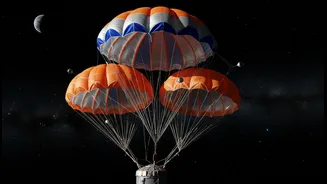
Bringing the Gaganyaan crew module from hypersonic reentry speeds to a gentle splashdown requires a meticulously choreographed sequence, not just one big parachute. The entire deceleration system consists of ten parachutes of four different types. The process begins when two apex cover separation parachutes deploy to jettison the protective cover that shields the main chutes from the heat of reentry. Following this, two drogue parachutes are deployed. These are not for landing but are crucial for stabilizing the capsule and reducing its velocity from supersonic speeds to a more manageable level. This initial braking action prevents the module from tumbling and ensures it is correctly oriented for the final and most critical phase of the descent.
Redundancy: The Golden Rule of Safety
Once the drogue parachutes have done their job and are jettisoned, the main event begins. Three pilot parachutes are deployed, each tasked with pulling out one of the three large main parachutes. Herein lies the system's brilliance and its answer to single-point failure. The system is designed to land the crew safely even if one of the three main parachutes fails to open. While all three main parachutes are intended to deploy for a soft landing, the system's success is not dependent on this perfect outcome. Two of the three main chutes are sufficient to slow the module to a safe terminal velocity for splashdown. This 'triple redundancy' is the key feature that eliminates the risk of a single parachute malfunction dooming the mission.
Designing Out the Weakest Link
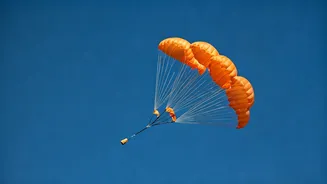
This design effectively means there is no single point of failure in the main parachute stage. The failure of one parachute does not create a cascading disaster; the other two are designed to handle the load. To ensure this works in practice, the main parachutes use a technique called 'reefed inflation'. Instead of inflating instantly, which could cause a dangerous shock, they open in stages. This controlled, gradual opening, managed by pyro devices, ensures the forces are distributed evenly and keeps the capsule stable, even in a scenario where one parachute is deploying slower than another or fails entirely. This multi-layered safety architecture with redundant triggering circuits and independent systems ensures a balanced and stable descent.
From Theory to Proven Reliability
To validate this robust design, ISRO, in collaboration with DRDO and the Indian Armed Forces, has been conducting an extensive series of airdrop tests. In these tests, a mass simulating the Gaganyaan crew module is dropped from an Indian Air Force IL-76 aircraft from an altitude of 2.5 kilometres to test the parachute sequence in real-world conditions. Recent tests, like the fifth Integrated Main Parachute Airdrop Test (IMAT-05), specifically focus on qualifying the main parachutes under the maximum expected load conditions. ISRO has even deliberately simulated failure scenarios, such as one main parachute failing to open, to prove that the system can handle the stress and still ensure a safe landing. Each successful test builds confidence in the reliability of the system ahead of the first uncrewed Gaganyaan-1 mission.