






The Anatomy of Airport Stress
The typical airport experience can feel fundamentally at odds with the needs of a family. Long walks down endless concourses are exhausting for little legs, while the constant barrage of announcements, bright lights, and crowds can lead to sensory overload.
For parents, the challenge is twofold: managing logistics like luggage and strollers while also trying to keep children safe, occupied, and calm. The result is often a tense waiting game where the primary goal is simply to get through it. This environment forces many families into a state of high alert, making the pre-flight period one of the most stressful parts of a trip, a hurdle to be overcome rather than a part of the journey to be enjoyed.
The Power of Purposeful Play
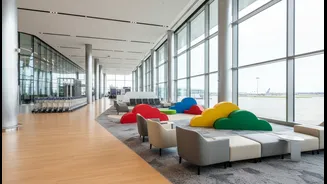
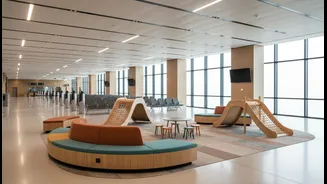
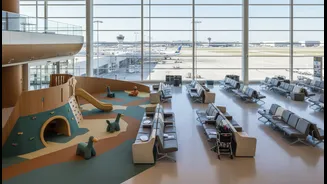
A key innovation in family-friendly airport design is the understanding that children need to move. Instead of trying to suppress this energy, leading airports are channelling it. Dedicated play areas are now a common feature, but the best go far beyond a few plastic blocks in a corner. Singapore's Changi Airport (SIN) is legendary for its multiple themed playgrounds, a four-story slide, and even a rooftop pool. Munich Airport (MUC) features an aviation-themed playground where kids can climb on model planes, while Hamad International Airport (DOH) in Doha uses artistic, sculptural play structures to engage children. These spaces are not just amenities; they are strategically designed to allow kids to burn off energy, reducing the likelihood of restlessness and meltdowns at the gate and on the plane.
Practicality Is Paramount
While play areas are the most visible feature, true family-friendly design is also about practical support. Many airports, including Paris Charles de Gaulle (CDG) and Istanbul (IST), now offer priority security lanes for families, which can be a game-changer after a long flight. Clean, well-equipped family restrooms with changing tables and child-sized facilities are becoming standard. Nursing rooms or private lactation pods offer a quiet, comfortable space for parents to feed infants. Some airports, like Tokyo Haneda (HND) and Hamad International, even provide complimentary strollers for use after security, lightening the load for parents navigating the terminal. These thoughtful touches address the real-world needs of travelling families, removing small but significant points of friction.
Calming the Chaos with Sensory Spaces
A growing and crucial trend is the creation of sensory rooms for children with autism, anxiety, or other sensory processing challenges. The overstimulating airport environment can be particularly difficult for these travellers. In response, airports like Pittsburgh International (PIT), Hartsfield-Jackson Atlanta (ATL), and Newark Liberty (EWR) have created dedicated quiet rooms. These spaces feature calming elements like adjustable lighting, bubble tubes, tactile activity panels, and comfortable, private seating areas. Presley's Place at PIT even includes a mock airplane cabin to help children familiarise themselves with the flight experience in a controlled setting. These rooms provide a vital sanctuary where families can decompress, making air travel more accessible for everyone.
Beyond the Basics of Entertainment
The most ambitious airports are transforming themselves into destinations in their own right, with entertainment options that appeal to all ages. Zurich Airport (ZRH) has observation decks where kids can watch planes, while Seoul Incheon (ICN) offers cultural performances and craft workshops. The Jewel Changi complex at Singapore's airport features the world's tallest indoor waterfall, a butterfly garden, and a movie theatre. In the U.S., San Francisco International Airport (SFO) incorporates museum-quality art installations to engage travellers. These features transform idle waiting time into an opportunity for discovery and entertainment, reframing the airport as a positive and memorable part of the family holiday.