




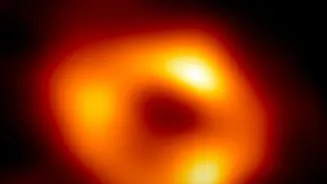
In the cosmic rulebook, some laws seem absolute. One of the most fundamental has been that black holes, the universe's gravitational titans, can merge and grow, but never, ever split apart. Now, new calculations are challenging that certainty.
The Unbreakable Rule of Black Holes
For half
a century, our understanding of black holes has been guided by a principle known as Hawking's area theorem. Derived by the legendary physicist Stephen Hawking in 1971, the theorem states that the total surface area of a black hole’s event horizon—the point of no return—can never decrease. This law is a cornerstone of black hole mechanics and has a curious parallel to the second law of thermodynamics, which dictates that the entropy, or disorder, of a closed system can only increase. When two black holes collide, the new, larger black hole they form has an event horizon with an area greater than or equal to the sum of the two originals, neatly obeying the rule. A split, however, would mean one large event horizon becomes two smaller ones, whose combined area would be less than the original. This would violate the area theorem, making it a seemingly impossible event.
Finding a Loophole in Spacetime
Recent theoretical research, however, has identified a potential loophole. A study published in the journal Physical Review D explores what might happen if the fundamental assumptions are changed. The key, according to the researchers, isn't to break the known laws of physics but to see if they apply differently under extreme and unusual conditions. The new calculations suggest that for a black hole to even have a chance of splitting, it would need to be rotating at, or incredibly close to, its maximum possible speed. For a non-rotating black hole, a split would cause a decrease in entropy, making it thermodynamically forbidden. But a rapidly spinning black hole might possess enough energy and angular momentum to overcome this barrier.
The Physics of 'Trouser' Topology
So how could this cosmic division occur? The researchers describe a bizarre-sounding process they term a 'pair-of-pants topology'. In this scenario, the event horizon of a maximally spinning black hole would warp and stretch, forming a shape resembling a pair of trousers. The original black hole represents the 'waist', which then constricts and divides into two separate 'legs'. Each leg would eventually detach to become an independent, smaller black hole. However, there's a major catch. For the split to be successful, the two new black holes must be able to escape each other's immense gravity. If they don't separate fast enough, they would simply fall back together and merge again. This requirement makes the conditions for a successful split extraordinarily narrow, closing the window of possibility almost entirely, except for black holes spinning at the absolute physical limit.
Why This Theoretical Split Matters
While nobody has ever observed a black hole splitting, and the conditions required are exceptionally rare even in theory, the implications are profound. This research pushes at the boundaries between two pillars of modern physics: Einstein's theory of general relativity, which governs gravity and the large-scale structure of the universe, and quantum mechanics, which governs the bizarre world of particles. A deeper understanding of black hole entropy and its limits could provide clues on how to unify these two currently incompatible theories, a holy grail for physicists. Furthermore, the study suggests that smaller, primordial black holes—hypothetical objects formed in the early universe—might be more likely to split than the supermassive ones we observe at the centers of galaxies.