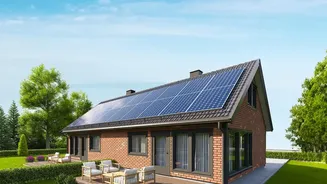







The Rooftop Real Estate Problem
For years, solar power has been hailed as a key to energy independence and lower costs. However, conventional solar panels, typically made from crystalline silicon, have a fundamental limitation: their efficiency. There's a ceiling to how much sunlight
a single-junction silicon cell can convert into electricity, with most commercial panels operating in the 18-22% efficiency range. This means that to generate a significant amount of power, you need a large surface area, which is a luxury many homeowners and businesses, particularly in dense urban areas, simply don't have. If your roof is small or partially shaded, installing enough traditional panels to make a real dent in your electricity bill can be impractical or even impossible.
How Perovskite Tandem Tech Works
Enter perovskite tandem solar cells. Think of it as a two-for-one deal for harvesting sunlight. This technology stacks a super-thin layer of a material called perovskite on top of a traditional silicon cell. The two layers work together, or in "tandem," to capture a much wider range of the solar spectrum. The perovskite top layer is excellent at absorbing high-energy light, like blue and green wavelengths. The light it doesn't absorb, primarily the lower-energy red and infrared light, passes through to the silicon layer below, which is optimised to capture it. By dividing the work, this stacked structure wastes far less of the sun's energy, overcoming the efficiency limits of a single material.
More Power, Less Space
The primary benefit of this tandem approach is a dramatic leap in efficiency. While the best conventional silicon cells have a theoretical efficiency limit of around 29%, lab-tested perovskite-silicon tandem cells have already demonstrated efficiencies well over 33%. One record certified in July 2026 reached an impressive 34.85%. For the consumer, this translates directly into more power generation from the same amount of roof space. A roof that could only support a system that covers half your energy needs with silicon panels might be able to cover much more, or even all, of your needs with a perovskite tandem system. This makes solar a viable option for a whole new segment of the population living and working in space-constrained environments.
The Hurdles: Durability and Availability
While the efficiency gains are exciting, the technology still faces challenges before it's ready for every rooftop. The biggest hurdle is long-term stability. Early perovskite materials were known to degrade relatively quickly when exposed to moisture, heat, and UV light—all of which are unavoidable for a solar panel. Researchers and companies are making significant progress with better encapsulation and more robust materials, with some pilot projects targeting panel lifetimes of over 10 years, but bridging the gap to the 25-year industry standard for silicon is a key focus. As of late 2026, perovskite tandem panels are not yet widely available for residential purchase, with commercialisation focused on pilot projects and specialised markets. Broader market penetration is expected between 2027 and 2030 as manufacturing scales up and long-term reliability is proven.