


A New Eye on the Cosmos
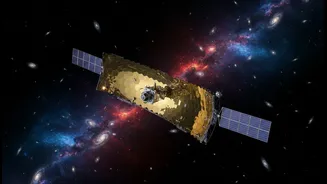
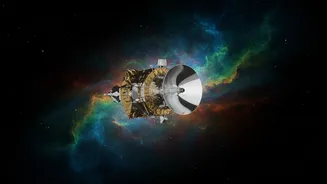
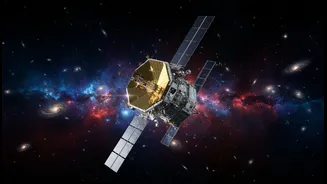
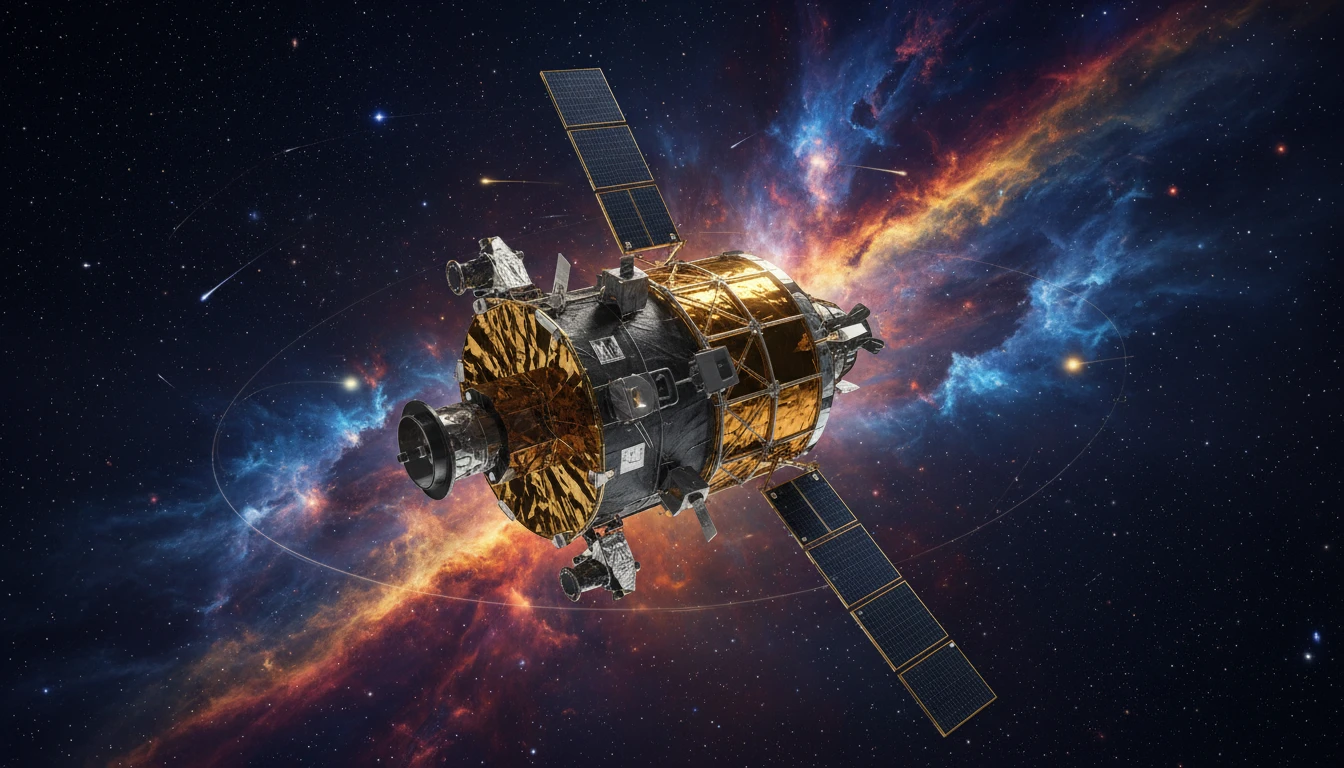
Set for an August 2026 launch, the Nancy Grace Roman Space Telescope is NASA's next great observatory, named after the agency's first chief of astronomy. While it has a primary mirror the same size as the Hubble Space Telescope's—2.4 meters in diameter—its
power lies in its extraordinary field of view. Its Wide Field Instrument (WFI) can capture an area of the sky at least 100 times larger than Hubble can in a single snapshot, all while maintaining a similar, stunning image resolution. Think of it as the difference between looking at the sky through a keyhole versus a giant panoramic window. This capability will allow Roman to survey huge swathes of the universe with incredible speed and efficiency, fundamentally changing the way astronomers gather data.
Charting the Unseen Universe
One of Roman's primary goals is to tackle one of the biggest mysteries in physics: dark energy. This enigmatic force is causing the expansion of the universe to accelerate, but scientists don't know what it is or how it works. Roman will address this by conducting the High Latitude Wide Area Survey, a monumental effort to map the positions and shapes of hundreds of millions of galaxies. By studying how the distribution of galaxies has changed over cosmic history and how their light is distorted by the gravity of intervening matter—a technique called weak gravitational lensing—scientists can trace the influence of dark energy and dark matter. This will create the largest and most detailed 3D maps of the universe ever produced, providing crucial clues about the fundamental forces that shape our cosmos.
A Census of a Billion Galaxies
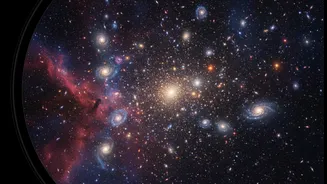
While Hubble’s iconic Ultra Deep Field image famously revealed thousands of galaxies in a tiny patch of sky, Roman’s wide view will perform a similar feat on a colossal scale. A single deep-field image from Roman is expected to capture millions of galaxies. Over its five-year primary mission, the observatory will measure the light from over a billion galaxies. This unprecedented survey will not only help in the study of dark energy but will also provide a rich dataset for nearly every field of astrophysics. Scientists will be able to study how galaxies form and evolve, investigate the supermassive black holes at their centers, and explore the stellar nurseries where new stars and planets are born.
Hunting for Thousands of New Worlds
Beyond mapping distant galaxies, Roman is also a formidable planet-hunting machine. Astronomers predict it could discover as many as 100,000 new exoplanets, or planets outside our solar system. It will primarily use a technique called gravitational microlensing, where the gravity of a star or planet acts like a magnifying glass, briefly brightening the light of a more distant star. This method is especially good at finding planets far from their host stars, in orbits similar to those in our own solar system, and can even detect rogue planets that drift through space untethered to any star. By surveying the dense starfields toward the center of our Milky Way, Roman will provide a galactic census of planets, helping us understand how common solar systems like our own truly are.